Showing posts with label Yorkist Victory. Show all posts

Friday, March 20, 2015

Battle of Northampton 1460

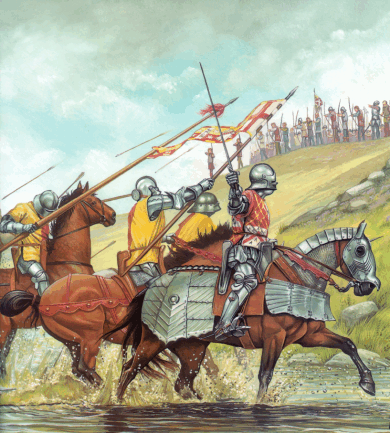
Battle of Northampton as depicted by Matthew Ryan
After nine months in exile, Yorkist commanders Earl of Warwick and Edward, Earl of March, led their forces to victory in the Battle of Northampton on 10 July 1460.

 BACKGROUND
After fleeing the Battle of Ludford Bridge, Yorkist commanders Duke of York, Earl of Salisbury and Earl of Warwick were able to consolidate in exile despite having their lands and titles forfeited in an act of attainder. 

The Lord Chancellor of Ireland, Earl of Rutland, was able to learn more about his office when he accompanied his father, Duke of York, to Ireland. The Irish welcomed York and he peacefully received Warwick in March 1460 in order to plan their return to England.

Warwick had enjoyed exile in Calais and was accompanied by his father, Earl of Salisbury, and York's eldest son Edward, Earl of March. Henry VI had previously replaced Warwick as Captain of Calais with Henry Beaufort, 3rd Duke of Somerset, but Calais rallied behind Warwick and denied Somerset entry into the city. 

Somerset eventually made landfall at Guisnes and appointed Andrew Trollope the town's bailiff. This appointment was mainly due to Trollope's knowledge of the area before he betrayed Warwick at Ludford. Somerset had several skirmishes with Warwick's men but his presence in France was more of an irritant than a threat to Warwick.

Warwick still had a ship moored at a dock in Sandwich on the English south coast and Margaret of Anjou sent the husband of long-time friend, Jacquetta of Luxembourg, to commandeer the vessel. Richard Woodville, who was now Earl Rivers, and his son, Anthony, arrived at Sandwich but were later taken prisoner by Warwick's men and taken across the English Channel to answer to Warwick. Warwick, Salisbury and March each ridiculed their captives, with Warwick berating Earl Rivers for being a son of a squire who had married himself into the nobility to become a lord.  

Sandwich was to be the location of the return of Warwick, Salisbury and March to England on 26 June 1460. The three commanders gathered support in the south-east and Salisbury stayed behind to garrison the Tower of London. Warwick and March marched further north and their forces of 10,000 men met the royal forces at Northampton. 

BATTLE
Northampton battlefield map
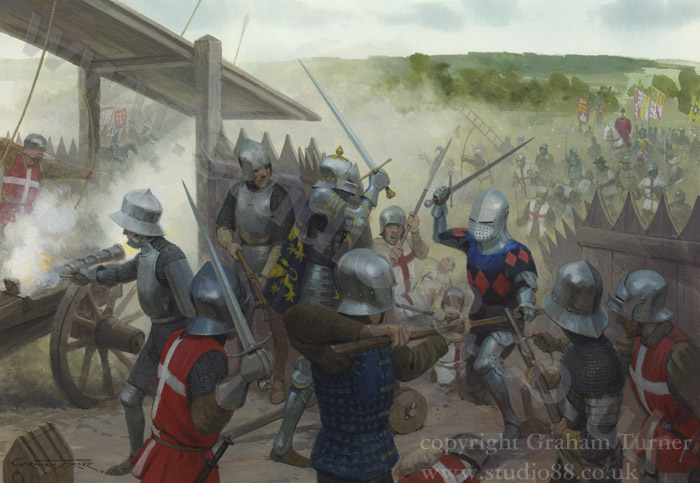
The royal forces took up a defensive position in the grounds of Delapré Abbey behind a water-filled ditch topped with spikes, and in front of the River Nene near Northampton. 

Warwick had previously sent three emissaries to present the Yorkist grievances to the king but were denied by Humphrey Stafford, 1st Duke of Buckingham. Buckingham sent word back that "The Earl of Warwick shall not come to the King's presence and if he comes he shall die." Upon arriving at Northampton, Warwick replied to Buckingham with the message that "at 2 o'clock I will speak with the King or I will die."

Warwick's army was twice the size of the Lancastrians and the Yorkists advanced at 2 o'clock into hard wind and rain. They were met with a fierce hail of Lancastrian arrows but the rain had made the royal artillery near useless. March took the vanguard up to the ditch guarding the Lancastrian right flank and his men were pleased to see Lord Grey of Ruthin offer a helping hand over the defences. 

Ruthin had personal gain from his treachery as March had previously agreed to support Lord Grey in a land dispute with Lord Fanhope.  The battle lasted just half an hour once the Yorkists were behind the Lancastrian front lines as the royal troops fled the king's defence. Henry VI had remained in his tent behind the frontline and his four lieutenants of Buckingham, Earl of Shrewsbury, Lord Egremont and Lord Beaumont, all died trying to stop the Yorkist approach to the royal tent.
A victorious Warwick kneels to Henry VI as depicted by Graham Turner
WIth the death of the despised royal councillors, Warwick and March respectfully greeted Henry VI, swore their loyalty to the crown and escorted the king to London. 

York now readied a return to England to claim the English throne for himself.

Battle of Blore Heath 1459

England's uneasy period of peace since the First Battle of St. Albans came to end on 23 September 1459 at the Battle of Blore Heath in Staffordshire.

BACKGROUND
Queen of England, Margaret of Anjou, had been growing in animosity towards Richard, Duke of York, and his supporters, Earl of Salisbury and Earl of Warwick. The Yorkist commanders were spread across the land with York at Ludlow in Shropshire, Salisbury at Middleham,Yorkshire and Warwick in Calais. 

Troops were being mustered on both sides and Salisbury took his men south to link up with York at Ludlow. The royal army was moving to Ludlow from Nottingham but Anjou, hearing of Salisbury's movements, instructed James Tuchet, Lord Audley, to intercept.

BATTLE
Audley chose the open ground of Blore Heath to press home his advantage of 10,000 men and cavalry. Salisbury took up defensive positions by digging a trench to his rear and fortified the front line with stakes. Audley took up position behind a steep, wide and fast-flowing stream that was out of range of Salisbury's archers.

Salisbury prompted Audley into a cavalry charge by ordering a portion of his line to retreat. Audley fell into the trap as Salisbury ordered his men to return and attack the cavalry crossing the stream. The Lancastrian infantry successfully crossed the stream in a second attack and a fierce melee ensued.
Lord Dudley leads the Lancastrian attack
Audley died in the fighting and his command was left to John Sutton, Lord Dudley, who led 4,000 infantrymen into the third and final wave. Dudley's cause soon deteriorated when 500 of his own men joined the enemy and attacked the Lancastrians. Dudley's men soon fled the battle and they were cut down by Salisbury's men. 

Salisbury, despite having half of the men, was able to take advantage of the land and his military tactics, to kill 2,000 Lancastrians to the loss of his 1,000 men. But Salisbury was aware of an approaching royal army, with Anjou five miles away at Eccleshall and Henry VI 10 miles away.

Salisbury showed further ingenuity in his undetected retreat from Blore Heath when he instructed a friar to fire the remaining battlefield artillery throughout the night. The royal forces of 15,000 men advanced to Blore Heath and were greeted the next morning by the lone friar. The friar replied to Lancastrian demands of why he stayed on the battlefield all night by saying he was "afraid to leave it."

York would later met up with Salisbury and Warwick at Worcester to prepare for a fight with the Lancastrians that came at Ludford Bridge on 12 October 1459.

Thursday, March 19, 2015

First Battle of St. Albans 1455

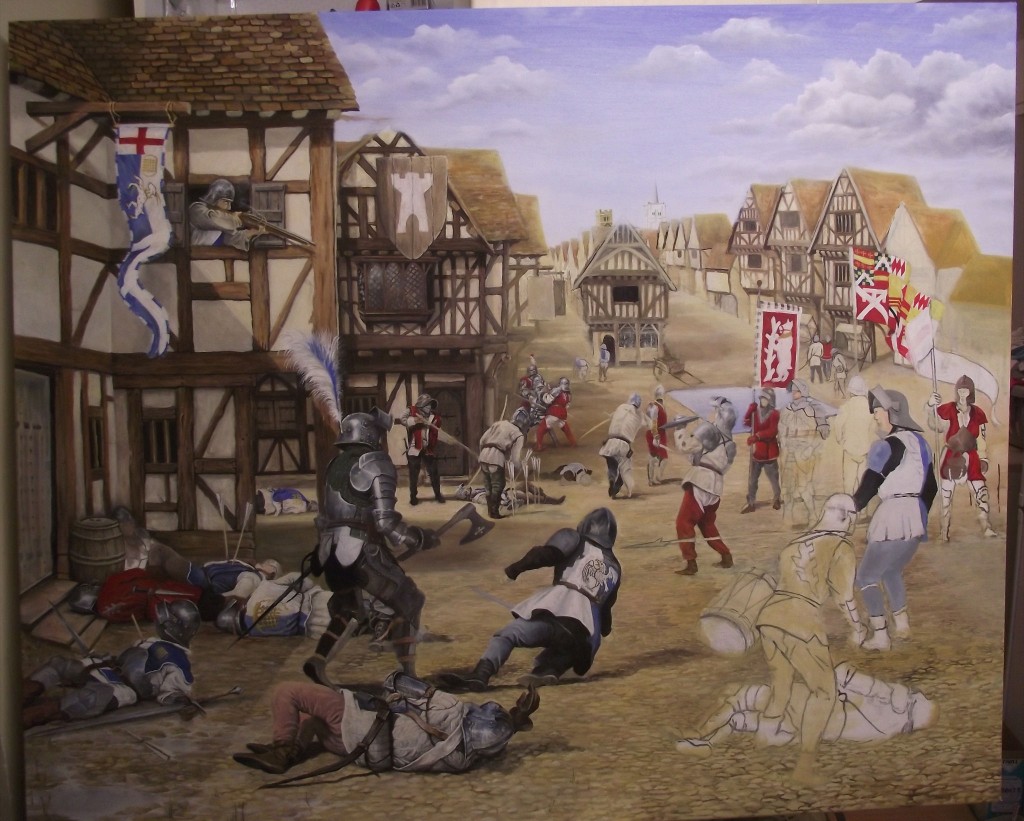
First Battle of St. Albans depicted by Matthew Ryan 
The 'Cousins War' or 'War of the Roses' fought between England's nobility began in earnest at St. Albans on 22 May 1455.

BACKGROUND
Henry VI's mental breakdown after heavy English defeats in France in 1453 brought the need for governance and Richard, Duke of York, became Protector of the Realm on 27 March 1454. 

York had held grievances with Edmund Beaufort, 2nd Duke of Somerset, ever since the king decided to make Somerset Lieutenant of France in 1448 instead of granting a third term to the incumbent York.
Battle of Castillon of 1453 depicted by Graham Turner
Somerset's term in office was disastrous, with the heavy defeat at the Battle of Castillon in 1453 leaving Calais as the only English territory in mainland France. York had previous animosity to Somerset's father when the king had shown favouritism towards the 1st Duke of Somerset by granting him, and not York, much needed troops in France 10 years earlier.

York charged the 2nd Duke of Somerset for failing to assert England's authority in France and imprisoned him in the Tower of London.  But Somerset was soon to be freed when Henry VI recovered in late 1454. Henry VI continued to antagonise York by removing him as Captain of Calais and replaced him with Somerset.

The king summoned the meeting of the Great Council in Leicester and York viewed this invitation cautiously. York met with his loyal commanders, Neville father and son, Earl of Salisbury and Earl of Warwick, and decided to march south with a growing force to meet the king before he arrived at Leicester.

York sent word to Henry VI and the Archbishop of Cantebury of his intentions to not harm the king due to his faith and allegiance but took up arms to counter the "sinister, malicious and fraudulent" members of government. 

BATTLE
Henry VI's army of 2,000 troops arrived at St. Albans first on 22 May 1455 and encamped along Tonman Ditch. The 7,000-strong Yorkist army arrived and made camp in Keyfield to the east of the barred town. Negotiations lasted three hours but broke down when York's demands of Somerset's surrender were denied. 

York led the surprise attack on the town before noon but was repulsed at the barricades by Lord Thomas Clifford and his men. Warwick outflanked the Lancastrians by rushing through the gardens between Key Inn and Chequer Inn and attacked Clifford's men from behind.

The battle through the streets of St. Albans lasted around half an hour as the Lancastrian rank and file deserted their nobles. Somerset, Clifford and Henry Percy, Earl of Northumberland, lay dead.  

Humphrey Stafford, Duke of Buckingham, sought sanctuary in the town's abbey after being hit in the face by an arrow and the Yorkist archers struck the king in the neck. Henry VI was left alone in St. Peter's Street and the king sought refuge in a tradesman's house until he was discovered by York.
Duke of York is told of Henry VI's whereabouts depicted by Graham Turner
York declared his faith to the crown and was ready to show the king his devotion with his men at any time. The king was escorted back to London and took up residency at the palace of the Bishop of London. 

York declared himself Constable of England and made Warwick Captain of Calais. Henry VI had another bout of mental illness during his imprisonment and York became Protector of the Realm once again. 

Henry VI recovered in February 1456 and York resigned his office of Protector. The king now accepted York's influence at court and allowed Warwick to keep his command of Calais. Henry VI showed faith in York by reinstating him as Lieutenant of Ireland and sent York to the Scottish border to defend against a possible invasion.