Thursday, April 9, 2015

Life in 15th Century England - Part 2


Life in medieval England was varied but centred around commerce, crime, punishment, healthcare and living accommodations. 

HOUSING
An Englishman's home is his castle and nothing indicated social class more than medieval housing. The Norman Conquest in the 11th Century led to castles being built throughout England and the original timber motte and bailey castles were soon replaced with imposing stone fortresses. Castle architecture in the 15th Century had developed into the Perpendicular Medieval Gothic style with fan vaulted ceilings, timber-trussed hammerbeam roofs and decorative designs carved with chisels.
A castle dissected and displaying it's various rooms
The focal point inside a castle or manor house was the Great Hall where guests were wined and dined. Torches, candles and a fireplace illuminated the room with stone floors covered by carpet or mats. The walls of the Great Hall were decorated with gold paint, tapestries, shields, banners and paintings whilst wooden panelled wainscot lined the room walls. The castle air would be perfumed with sweet herbs such as lavender, camomile or rose petals to mask the pungent smells coming from the privy. 

The Great Hall was furnished with a main table positioned on a dais that was surrounded with chairs painted with the heraldic designs often in red, green, white, yellow and black colours. Other guests sat on wooden benches around trestle tables which would allow a quick removal for after-meal entertainment or sleeping area for servants.

Lords and Ladies slept upstairs in the Great Chamber or Solar that was named after the sun shining through the south faced windows. The solar was also used as a private sitting room and was furnished with beds, chairs and chests. Personal servants also slept in the solar on a portable pallet for added protection.
A bower would provide privacy for a Lady
The solar was connected to the bower room and was used by the Lady of the House and her ladies in waiting for embroidery, reading and music. The bower would be decorated with colourful tapestries, furs and pillows and the withdrawing room would later be renamed the drawing room. Clothes and jewels were kept in the wardrobe room that was connected to the solar and was an improvement from the original garderobe where clothes were kept in the latrine to deter moths.

Prayers were expected four times a day and would range between five and 30 minutes. Mass would be heard in the castle or house chapel and the small oratory room attached to the chapel would provide sanctuary for a private prayer. The oratory would be richly decorated with beautiful altar clothes and rich religious tapestries. 
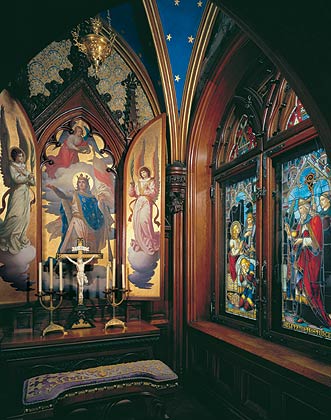
Medieval oratories would have been similar to this German one
The castle was a symbol of power and had to be protected from enemies. Archers would be perched in the crenels on the battlements on top of the castle and would reload behind the stone merlons. The battlements also provided an ideal vantage point for defenders to view their oncoming enemy and the Duke of York likely weighed up his options looking down on to Wakefield Green from the battlements of Sandal Castle on the morning of 30 December 1460. York would later venture out on to the field in front of the castle and would meet his death there at the Battle of Wakefield.  

Wakefield was one of many towns throughout England with towns and villages consisting of farmers and tradesman living in houses and barns sheds clustered around the centre of the village. Commoners lived in houses of one or two rooms that were covered with thatched roofs and built together with wooden frames filled in with wattle and daub that consisted of strips of wood woven together and covered in a 'plaster' of animal hair and clay.
A medieval townhouse
More affluent towns had houses made of stone which were whitewashed or painted in bright colors with wooden shutters letting in the sunlight. An open fire was used for cooking and heating In the middle of the straw-covered earth floor and commoners sat around on benches or stools. Wooden table and chests stored clothes and other valuables while tools and utensils were kept on hooks. Rush lights dipped in animal fat illuminated the room animal fat.

Commoners were either free men or as "villeins" who bound to the land, working heavy labour for their lord and were subject to feudal dues. Village life was busy for both sexes and women would toil in the fields, wearing simple dress and living on a meager diet.

Outside influences would affect village life as trade began to spread as people began to be drawn to bigger towns and cities.

COMMERCE
The annexation of Flanders by the Burgundian empire allowed English traders to have easy access to exotic imports such as silks and spices. Merchants were soon protected by treaties and government troops whilst the workers banded together to form Guilds. A wide range of trades formed these guilds including bakers, butchers, grocers, millers, smiths, carpenters, weavers, masons and cobblers. Industry standards such as weights and measures were governed by the guilds and inspectors would visit shops to ensure compliance. The guilds would also assist members who were sick or in trouble and would often take care of families following a member's death.
A smith shows of his wares
Traders would teach their knowledge and skills to apprentices would also act as their master's domestic servant and helper. Upon completion of the apprenticeship, the relevant guild would certify them as journeymen who would travel across towns to learn more about the trade.
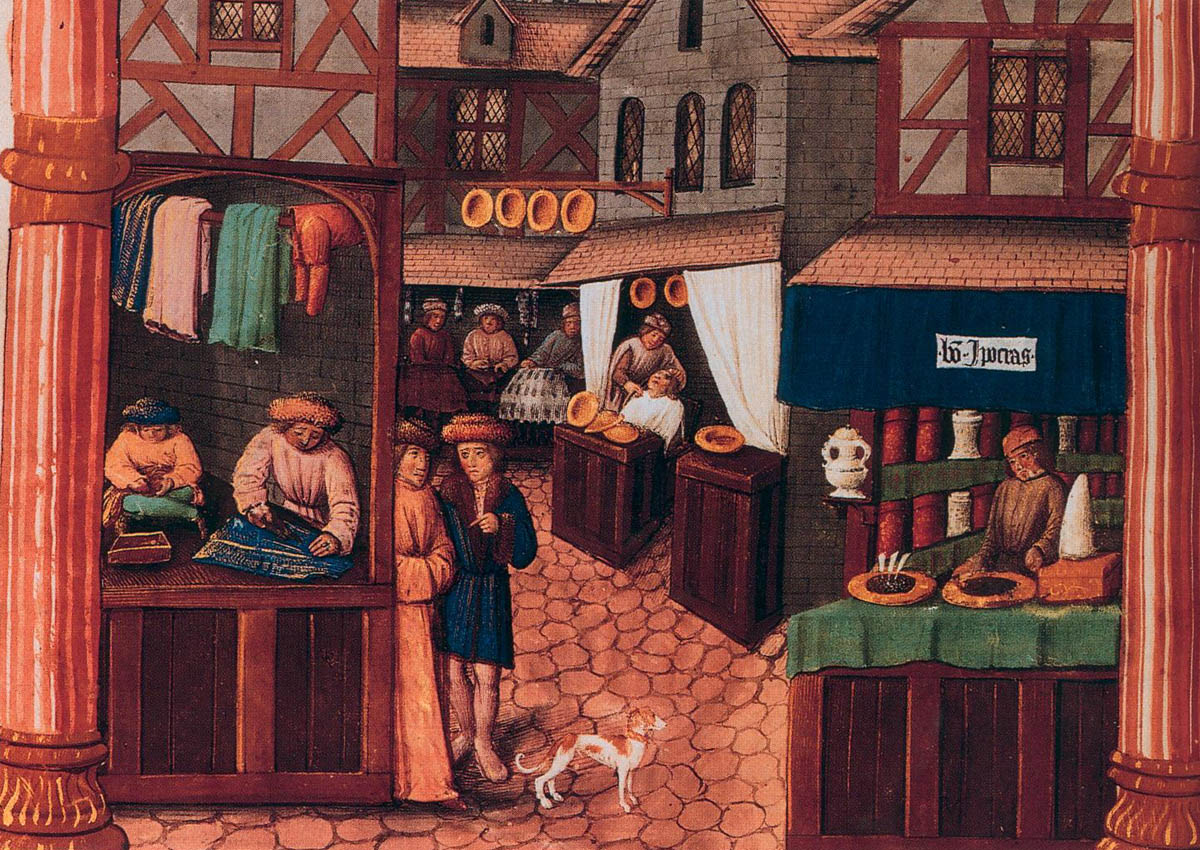
Market stalls in the town square

The market square would be at the centre of a medieval town and would hold markets at least once a week where local merchants would set up stall and sell their wares. Fairs were held several times a year and would attract foreign merchants into bringing fine wool, silks, spices, carpets and other items from far away lands. These fairs would last for days and would often attract performers such as strolling minstrels, performing tumblers, acrobats, and animal acts with trained bears and horses. 

CRIME & PUNISHMENT
The growth in population led to an increase in crime and the evolution of English justice from the Magna Carta would see juries of 12 men or a justice of the peace pass judgement. 

Gaols would generally be used to hold prisoners awaiting trial and Richard III's brief reign saw judicial reform that looked to protect the rights of the accused. Those who couldn't afford legal representation could have their cases heard by the Privy Council and the court would later be known as the Court of Requests. Bail legislation was also reformed to protect suspects from being imprisonment awaiting trial and asset seizure whilst ordering the translation of Laws and Statutes into English.
Petty crimes resulted in public shaming and humiliation
The sentences handed out to convicts would often involve severe punishments that looked to deter others from doing the same. Petty crimes resulted in being placed in the stocks to be publicly humiliated and shamed, stealing food to survive was punished with a hand being chopped off. More serious crimes would lead to punishment by death with heresy punished by being burnt at the stake, murderers were hanged and traitors would be executed by being hung, drawn and quartered in public as a deterrent.

The barbaric punishment of being hung, drawn and quartered would see the condemned hanged until they were half dead, taken down, and quartered by having their limbs torn by horses pulling them apart. The convict was still alive when their genitals and bowels would be cut from their bodies and thrown into a fire until finally being killed by decapitation.
Traitors would often be displayed as a warning to others
The body parts of traitors were often displayed as a warning to others like Jack Cade's torso being sent to the four corners of the rebel's home county of Kent and the decapitated heads of the Duke of York, Earl of Rutland and Earl of Salisbury were displayed on spikes atop of Micklegate Bar in York.

HEALTH
The Black Death had ravaged England in the 14th Century and fears of it returning were never far from the minds of those across all social classes. The wealthy would often live longer than the poor due to the unhygienic common living quarters of the commoners where a village or town street would be littered with human and animal waste. The town's sanitation would involve buckets of waste being thrown into the street whereas the wealthy were able to rid of their waste down the privy chute into a nearby moat or stream.

Monasteries had provided healthcare and lodging for the infirm for centuries but the lack of regular hospitals would lead to traders doubling up as doctors that included barbers as surgeons and gave rise to the village apothecary.
Health was often governed by the stars
The theory of the Four Humors from Greek doctor Galen was practiced over a millennium later and the unbalanced humors would be treated with blood letting either through piercing the skin or leeches. Religion, superstition and medical ignorance saw health governed by the stars and death or disease being reasoned by God's wrath in the form of omens. Such omens included the Solar Eclipse on the day of Queen Anne Neville's death or the rise of the sweating sickness after Henry Tudor had landed with French mercenaries in 1485 to claim the throne. 

Wednesday, April 8, 2015

Life in 15th Century England - Part 1


Life in medieval England was varied but was dominated by by religion, food, drink and entertainment.


RELIGION
Christianity was the only religion in 15th Century England and was practiced as the Catholic denomination. The church dominated the life of every social class whether it be peasant, serf, noble, lord or King and the religious institutions of monasteries and convents grew in power.
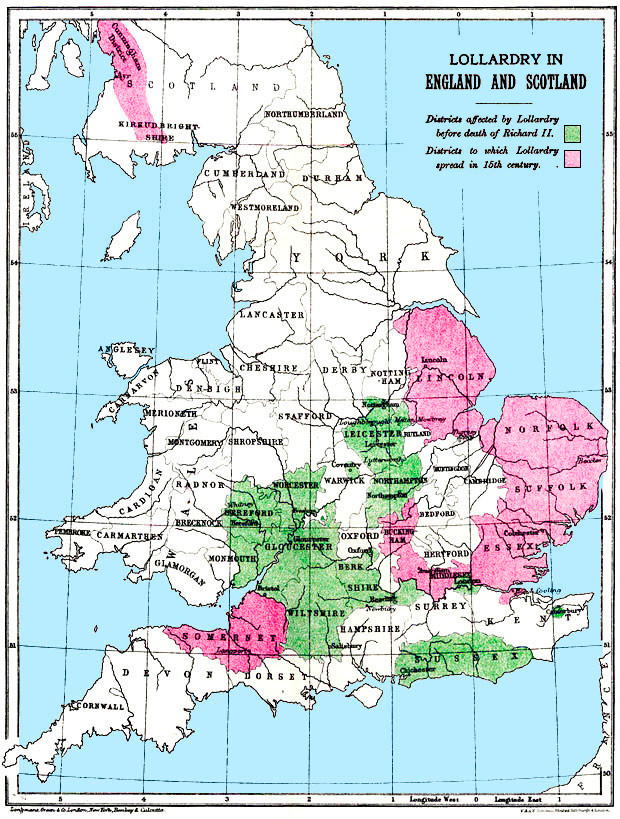
Lollardy spreads across in England in the 14th (blue) and 15th (red) centuries
Those who found the Catholic faith overbearing and corrupt became part of the Lollard movement which challenged traditional values such as priest confessionals. The movement was led in the late 1300s by John Wycliffe and supporters included KIng Henry V's friend, Sir John Oldcastle. Oldcastle was imprisoned for his beliefs in 1413 and plotted to kidnap the king after escaping. Oldcastle's rebellion failed and Lollards were persecuted following Oldcastle's execution. Lollardy would later influence Protestantism in the next century but was driven underground in the 1400s after spreading across the southern and middle England.


Medieval monks practiced the three main vows of poverty, chastity and obedience by renouncing all worldly goods and spent their lives working under a strict routine. This routine would include worship, reading, farming and manual labor. Monks ate a simple diet of bread and meat with pallets filled with straw for beds. Nuns spent several hours in private prayer in convents whilst their education was closely screened by the Church. A nun would be tasked with several tasks and chores which included cooking, cleaning, weaving and illuminating manuscripts.

A Medieval monk would divide their day into the eight sections of the prayer book Book of Hours that were meant to be read at specific times of the day. Each section contained prayers, psalms, hymns, and other readings intended to help the monks secure their salvation. Matins would be recited at 2am, Lauds at 5am, Prime at 6am, Terce at 9am, Sext at noon, Nones at 3pm, Vespers between 4-5pm and Compline at 6pm.


Richard III's Book of Hours
A Book of Hours accompanied Richard III at the Battle of Bosworth and contained the following prayer:

"Lord Jesus Christ, deign to free my, your servant King Richard, from every tribulation, sorrow and trouble in which I am placed…hear me, in the name of all your goodness, for which I give thanks, and for all the gifts granted to me, because you made me from nothing and redeemed me out of your bounteous love and pity from eternal damnation to promising eternal life.” 

Children would study the Christian saints' patronage, holiness and feast days and Richard III must have been fascinated with numerous saints sharing the names of his siblings. His brothers Edward and Edmund were named after the saints Edward the Confessor and Edmund the Martyr who were kings of England and East Anglia respectfully whilst George was named after the patron saint of England. Richard III's sister Margaret was named after the Wessex princess who married into the Scottish royal family and eldest sister Anne was named after the mother of the Virgin Mary. Anne's lineage would provide crucial in profiling Richard III's DNA after the king's skeleton was unearthed in 2012.


Religious devotion was shown in abstaining from certain foods during the seasons of Lent and Advent in accordance with the sacrifices of Jesus Christ. Meat was also banned during certain observances on Mondays, Wednesdays and Fridays throughout the year. 

FOOD & DRINK
Medieval diets, like the fashions of the day, were dependent on social class. Nobles and lords enjoyed a wide range of meats including fowl, lamb, beef, bacon and fresh water fish for those living close by. Milled flour, cheese and butter could also be found on a noble's dining table. 

Richard III's ascent to the throne was also shown in his diet with bone chemistry analysis conducted by the British Geological Survey showing that the king ate more regal birds such as swans and herons and drank more wine in his brief two year reign. 

Commoners had a much simpler diet of root vegetables, rye bread, lentils, beef, pork, milk and cheese. Bread was baked in village communal ovens and biscuits were conveniently eaten by common workers. Only lords and nobles were allowed to hunt for deer, boar, hares or rabbits and commoners ran the risk of having a hand chopped off if they were caught poaching. 

The high fibre, low fat and calorie diet lacked vitamins A, C and D and this would lead to bad teeth, skin diseases, scurvy and rickets. Raw vegetables and fresh fruit were viewed with suspicion as vegetables were cooked in soups and common stews whereas nobles enjoyed fruit pies made from apples, cherries and raspberries. Nobles could also afford sugar and Asian spices and their cooks were able to concoct exotic recipes. 
A castle kitchen hard at work
To avoid the food from spoiling, cooks would preserve food in the summer to be eaten in the colder winter months and items which couldn't be preserved were only eaten in season. The cost of maintaining animals during the winter caused them to be slaughtered in the autumn and this meat would be preserved using salt. The meat would either be buried in dry salt or soaked in salty brine water and the overwhelming salty taste would be combated with Asian spices like pepper, cinnamon, nutmeg and ginger. Food would also be preserved in pickled vinegar, solidified jelly or would be wood smoked, dried, candied or honeyed.  

Castle kitchens were located on the ground floor and would contain a great hearth where meats of beef, pork and poultry would be spit-roasted or smoked whilst boiling pots hanged above the fireplace. Pies and wheat-floured manchet bread were baked in the cooking ovens. The kitchens were built against the castle's curtain wall and were supplied with water in a sink and drain. Surrounding the kitchens were various store rooms with the pantry containing perishable foods, wine was stored and dispensed in the bottlery and a butler presided over ales in the buttery.
Alcohol was the medieval beverage of choice as untreated water had a foul taste and was full of disease. Beer had been brewed in England since the Roman times and a growing number of fermented grains had led to the introduction of stronger ales. Different spices and fruits added flavour and led to other drinks with honey used in mead, apples used in cider and grapes, pomegranates and raspberries used in different wines.

English grapes would often turn sour as the climate prevented ripening so most wines were imported from France and the Mediterranean which provided too expensive for commoners. The sweet Malmsey wine from the Portuguese island of Maderia was said to be used for darker means as it was rumoured that Richard III's brother, George, Duke of Clarence, was punished for treason by being drowned in a butt of malmsey. 
Malmsey was said to be used for more darker methods
The prepared meals would be served to guests in the Great Hall and would be eaten off gold or silver plates with silverware containing knives and forks. Commoners would use wooden dishes and would sup their soup bowls without spoons. Food was often served cold due to the distance between the kitchen and the Great Hall.
Servants provide food platters in between banquet courses
Supper was the main meal of the day and was served between 6pm-7pm. Dishes were placed on a Great Table set upon a dais and covered in cloth. Guests washed their hands at the entrance of the Great Hall before taking their seats. The meal would vary between three and six courses which were accompanied with various forms of entertainment. 

ENTERTAINMENT
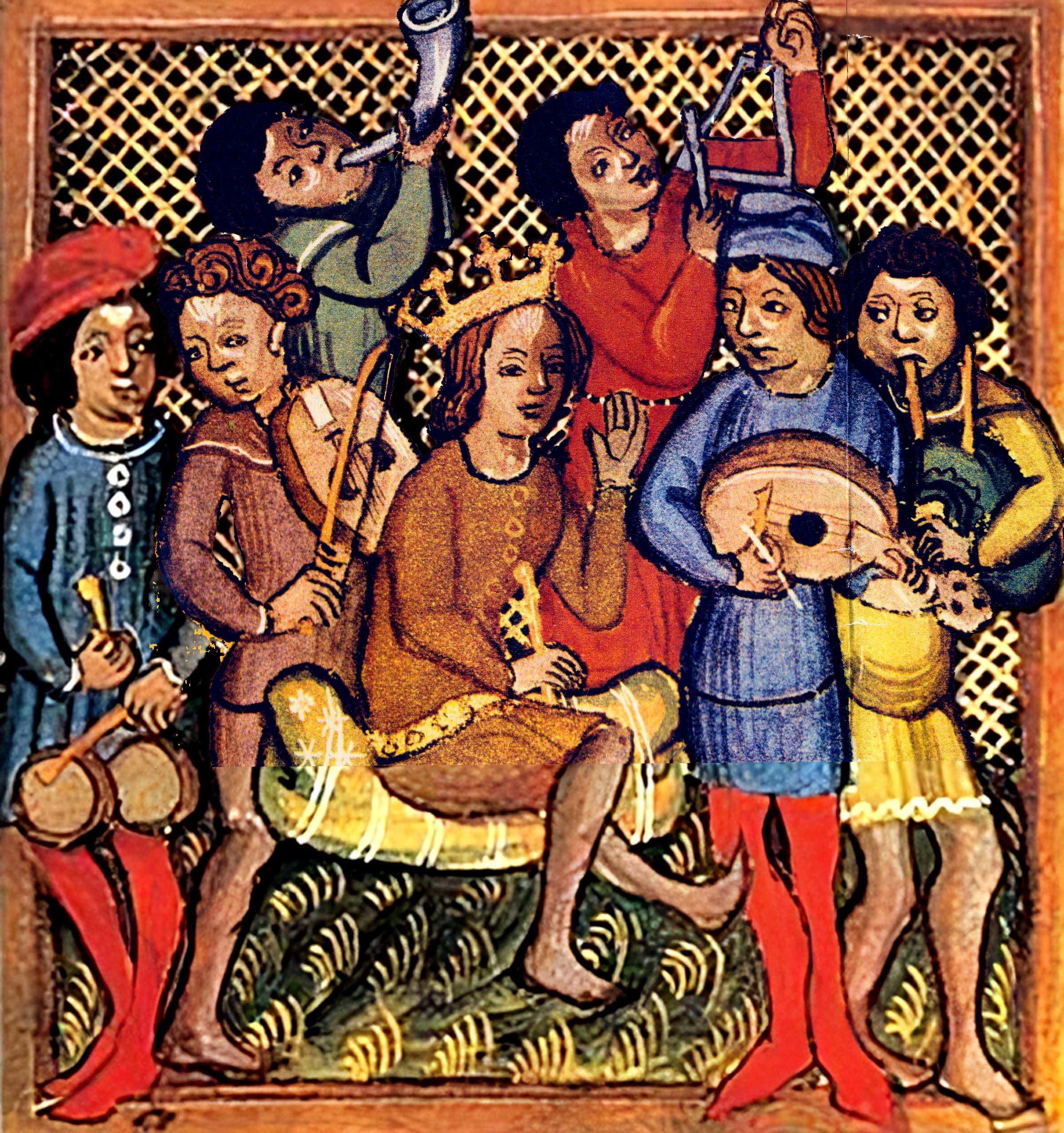
The Great Hall would be filled with entertainers who would serenade the guests as it was believed music would aid digestion. Troubadours would perform romantic ballads of chivalry and courtly love on lutes, flutes, horns, trumpets and drums. Minstrels would provide music from above the Great Hall floor in the Minstrels Gallery where harps would accompany ballads and recitals of mythical poetry.
Troubadours entertained nobles during meals
After-meal entertainment was provided with court dances such as the volta and jongleurs would juggle, conjure and tumble but the itinerant entertainers were deemed vagabonds and untrustworthy. Entertainment wasn't just confined to court as commoners also enjoyed partying. Towns would employ musicians called Waits who composed and played music for important occasions and ceremonies.

A dance would often follow noble banquets
Uplifting and romantic chivaree music was played at weddings and on St. Valentine's Day whilst buoyant and cheery music of horns, trumpets, whistles and bells built to a crescendo. Mayday celebrations included dancing around a maypole to high-pitched music that was believed to reawaken the hibernating spirits for the onset of spring.

Feast days of pagan origins were celebrated often with the grandest feast taking place at the dreariest time of year. The 12 days from Christmas Eve to Twelfth Night on 5 January was a time of rest for servants who were gifted with food, clothing, drink and firewood. Houses were decked with holly and ivy whilst giant Yule logs were brought in and burned throughout the 12-day Christmastide celebrations. 
A Christmastide procession was part of the festivities
Christmastide 1460 was an agreed upon period of truce between the Duke of York and Henry Beaufort, 3rd Duke of Somerset and this truce came to a brutal end on 30 December 1460 at the Battle of Wakefield.  

Thursday, April 2, 2015

15th Century Fashion


The 15th Century was the final period of the medieval era and fashions in England at the time reflected this. The English Renaissance occurred in the 16th Century but England's 1400s fashion was influenced by Europeans due to the nearby flamboyant Burgundian court.

The Duchy of Burgundy at it's height stretched from the North Sea shores of Flanders to the peaks of the Swiss Alps and gave access to trading routes where Italian and Eastern fabrics were traded to English wool merchants via the ports of Bruges and Antwerp.

Wool was a popular fabric due to it's versatility from rough undyed cloth to fine, dense broadcloth with a velvety nap. The English economy thrived on high quality broadcloth, being exported throughout Europe with dyes bringing rich colours of reds, greens, golds, and blues.
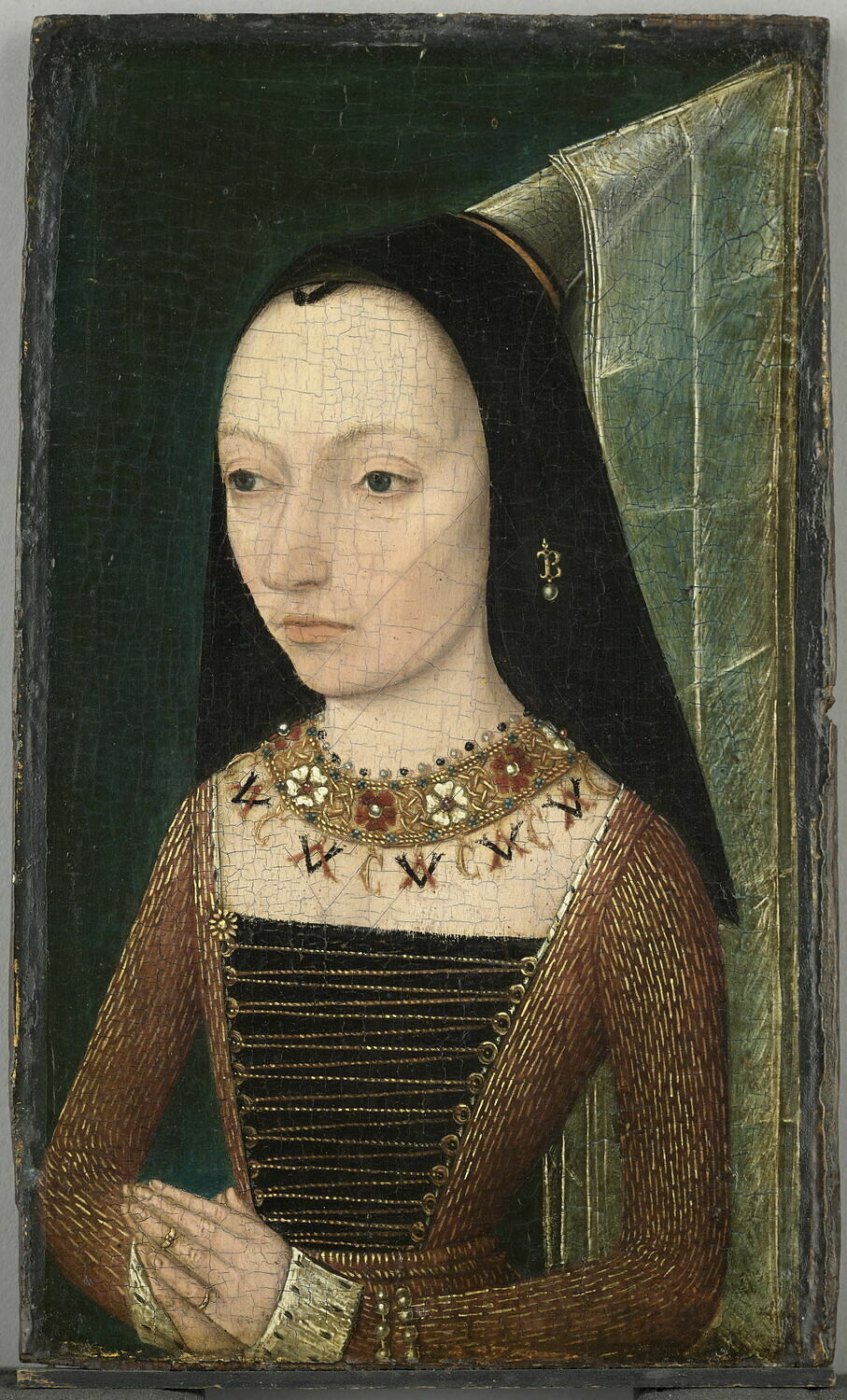
Margaret of Anjou wearing a white ermine fur-lined gown
Linen and hemp were also popular but Asian silk extravagance of silver-gilded wefts and stately floral embroidered motifs were worn by the richest of nobles. Furs would often be worn by the nobility with linings of dark brown sable or marten and white ermine furs.


NOBLE WOMEN
Women in the 15th century would often be dressed in a long gown with a low cut V-neck that would reveal a decorated square-necked kirtle and below this would be a linen chemise worn next to the skin. Gown skirts would often be carried looped-up to allow walking and were high-waisted, tightened with a belt. The heavily ornamented sleeves could be detached from the gown whilst the lining of the sleeve cuffs would match that of of the fur or velvet-trimmed neckline.
Elizabeth Woodville's matching cuffs, neckline and truncated English hennin
Various overgowns were worn but the most popular was the houppelande with the snug sleeves at the wrist creating a full "bag" sleeve that was sometimes slashed in the front to reveal the lower arm. The sideless surcoat of the 14th century had since been retired to royal ceremonial costume with it being confined to special occasions and royal portraits.

Head-dresses had developed from simple hairnets into ornate pieces with the hair pulled back to accentuate their designs. A heart-shape padded roll, or a veil was worn on the headpiece and wire frames exaggerated the veils that draped from the back or front of the headdress.
Margaret of York, Richard III's sister and Duchess of Burgundy, wears a veiled hennin
The most extravagant headdress was the cone-shaped hennin that was adorned with a fabric-covered wire frame and topped with a floating veil. The fall of the Burgundian empire in the 1480s saw noble head-dresses resemble those of the merchant classes with smaller, more convenient, and less picturesque designs. 

Social status was also shown in jewellery as previous laws restricted commoners from having precious stones, pearls and excess amounts of gold and silver. Noble women wore intricate and elaborately decorated rings, necklaces, brooches, lockets, belts and purses. Their personal possessions such as combs and book-covers were also be jewelled. Much of the jewels were imported and used as security against loans. 

The noble woman's attire was complete with laced ankle-boots, often lined with fur and these were later modified with the pointed toe of poulaines. 


NOBLE MEN
A nobleman's wardrobe wasn't as varied but was just as orate as women's as they wore a shirt, doublet, hose, and an overgown robe. The linen shirt sleeves were often pulled through the slashes of the covering doublet to make embroided puffs that were embroided  at the elbow and back of the arm. 
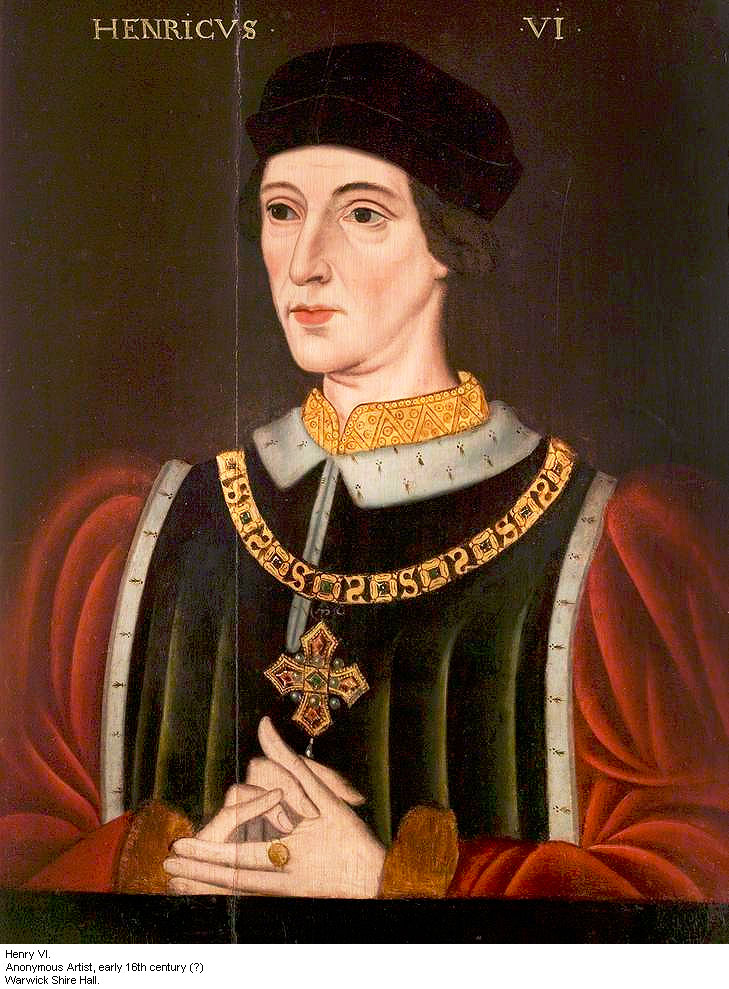
Henry VI wearing a green doublet and black hat
A doublet was worn over the shirt and they would be tightly fitted with either belts or tailored designs hugging the waist, giving the effect of a short skirt below. The doublet would often be elaborately pleated, especially at the back. The solid torso design was contrasted with long attenuated legs and feet with extremely tight wool hose and long pointed poulaine shoes or thigh-boots. 
Sharp pointed toe poulaines worn in Burgudy 
The loose linen undergarment breeches were worn by men across all social classes and were held up by a belt that would also tighten the hose. As doublets became shorter, the hose would reach over the hips and up to the the waist. The two hose legs were sewn together into a single garment with a pouch or flap covering the front opening and would later evolve into the codpiece.
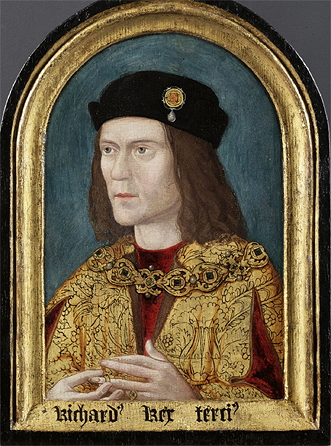
Richard III wearing a golden houppelande, chain collar and cap badge
Noblemen would wear a houppelande over their doublets with padded shoulders and full sleeves. The houppelande was often lined with fur as the hem and sleeves were cut into scallops. The wrist-length sleeves were full, forming a bag or sack sleeve, or were worn off the arm, hanging ornamentally behind. Cloaks or mantles were worn during ceremonies and in bad weather with a fastened brooch on one shoulder.

Men of all social classes covered their heads in the early 1400s with a hood and frequently wore it around the neck as a cowl or twisted it into a chaperon. Hats soon developed and varied from tall-crowned small brim hats to low-crowned, wider brims that were pulled in front into a point. These hats would be adorned with ornate cap badges and noblemen would also wear jewels on rings and large chain collars. The hats would cover hair usually in a bowl-cut style, with the hair shaved at the back of the neck but the hair would later be grown to shoulder length. 

COMMONERS
English commoners wore plainer clothes compared to the nobility due to cost and greater practicality. Women spun wool into cloth for their family's garments with them wearing long gowns covered by sleeveless tunics and wimples over their hair. A wimple was either a square or circular piece of material that was draped over the head to the shoulders and held in place by a band around the brow. 
Hay is gathered by barefoot women in long-sleeved smocks, Les Très Riches Heures du duc de Berry.
Men were dressed in short shirts and drawers that were almost never laundered, but the linen underwear was regularly washed. Sheepskin cloaks and woolen hats were worn in winter and leather boots were covered with wood to keep the feet dry. Cloaks would be tied with a belt that contained a knife, work tools and purse.

CLERGY
Long woolen habits were worn by the holy order in emulation of Roman clothing. The habits indicated which order they belonged to with Benedictines wore black, Cistercians wore undyed and the Franciscans wore grey, like the Greyfriars who originally buried Richard III. St. Benedicts monk were allowed to wear linen coifs to keep their heads warm after their saint stated a monk's clothes should be plain but comfortable. The Poor Clare Sisters, an order of Franciscan nuns, however had to petition the Pope in order to be permitted to wear woolen socks.
Nuns with different lengths of scapula
Nuns had two habits, two wimples and veils, a scapular for work, shoes and stockings. The extra habit allowed for washing and night-time wear.  A nun's habit was tied around the waist with a cloth or leather belt and a scapula cloak was worn over the shoulders with an opening for the head. The front of the scapula was secured with a small piece of rectangular cloth that snapped the sides together and a wimple or veil was attached to the scapula. Some nuns would also wear a cross upon a chain around their necks

Wars of the Roses Weaponary and Tactics


The wars raged across 15th Century England made it essential for forces to be properly armed and protected.

ARMOUR
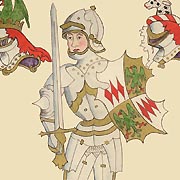
Men-at-arms in the thick of the action were fitted with heavy armour with a breast-plate underneath a leather brigandine or chain-mail hauberk. Attached to the breastplate were the plate armoured gorget around the neck, pauldron over the shoulders, couter over the elbows, vambraces over the forearms, tassets over the thighs and culet over the lower back. Added protection was found with plate-armoured gauntlet gloves and knights wore lance rests attached to the breast plate to steady their lances for a firmer blow.
Horses were also glad in plate armour
The main disadvantage of heavy armour was the lack of mobility and the quick-moving infantry wore a mail shirt over a padded aketonmail, with added munitions plate covering the most important body parts.  Light armour mostly consisted of padded cloth and leather with the archer's bracer providing a leather armguard to protect the fletching of an arrow. 
A Richard III re-enactor wears a crowed sallet helmet
Helmets also varied in design depending on how much protection was needed. Heavy helmets were made from steel plate, covered the head with visors on bascinets, armets, sallets and close helmets. Richard III was likely wearing a crowned sallet when he charged Henry Tudor at the Battle of Bosworth.

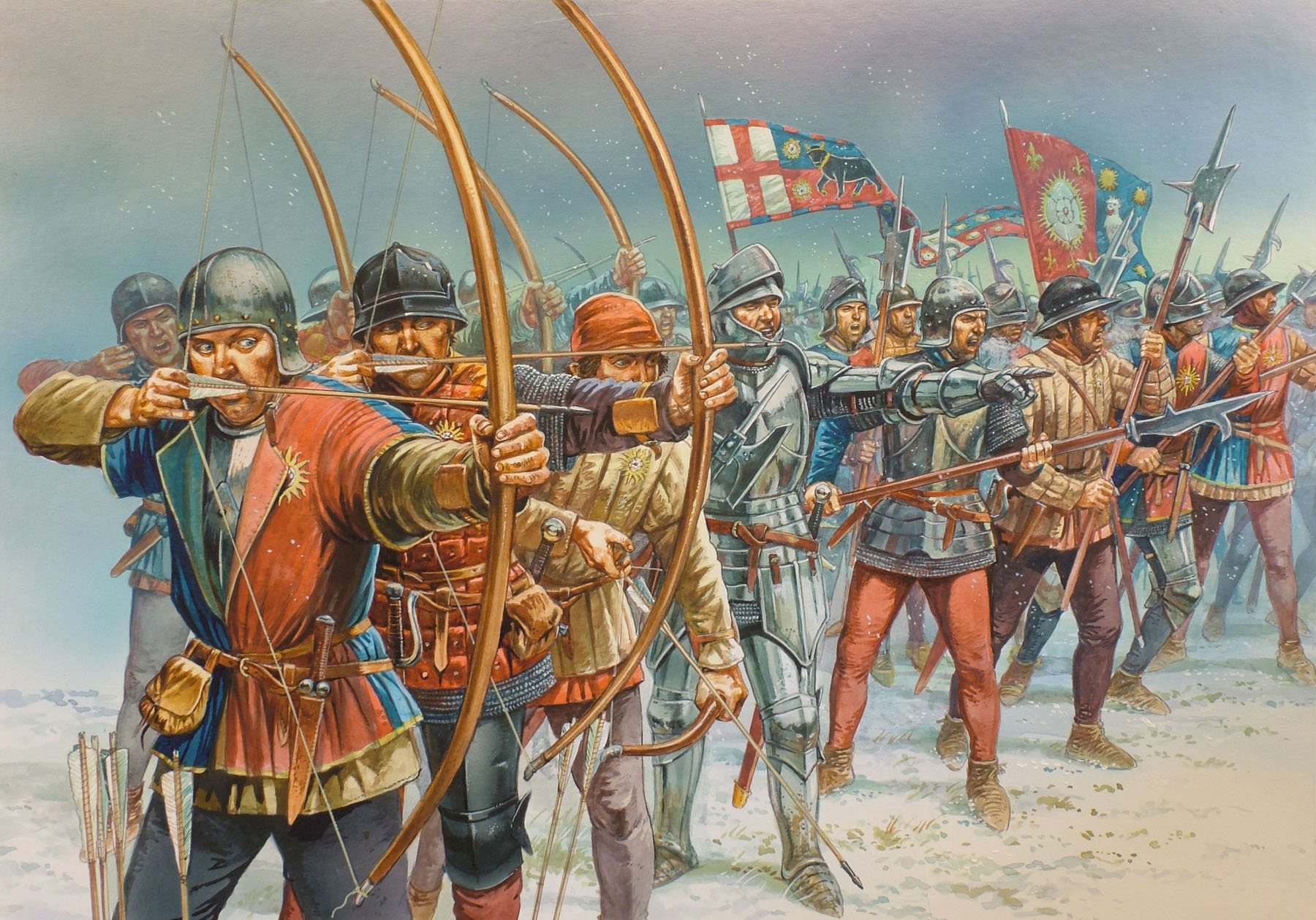
Medium helmets were made of steel, but didn't protect the entire head like the visor-less barbute helmet. Light helmets were usually caps made of cloth and leather but archers preferred the wide-brimmed steel kettle hats for greater field of vision and to shield their eyes from the sun. Helmets were often customised with different colours, plumes, coifs and bevors. 
Archers wore kettle helmets to shield their eyes from the sun

COMBAT WEAPONS
The advancements in protective armour led to the development of the longsword which allowed a double-handed grip with the sword's longer hilt. The finest swords of the era were stamped with a German Passau wolf and the unusually hard Toledo steel forged in Spain. Daggers were often used as a side-arm and the small, sharp bladed wound on top of Richard III's skull showed that they were used as execution weapons, with two hands likely used to push the pommel into Richard III's skull.

Other weapons used by men-at-arms included hammers, maces, axes, spears and pole arms like the halberd. The halberd was inexpensive to produce and very versatile in battle as the hook and axe head were able to pull horsemen to the ground. The large hole at the base of Richard III's skull shows that a halberd likely sliced the back of the king's head and struck the fatal blow. The bill hook was also effective at bringing down a horseman with the pronounced hook able to find a chink in the knight's armour. 
A halberd likely struck the fatal blow to Richard III
Men on horseback attacked in triangular formations, with the most heavily armored knights at the front. They defended themselves with shields and attacked with a wooden lance that would shatter upon impact. Richard III was the head of a triangular formation charging towards Henry Tudor and his lance shattered into the helmet of Tudor's standard bearer, Sir William Brandon.

RANGED WEAPONS
The longbow gained it's notoriety at the Battle of Agincourt with a fast reload, accurate archers, armour-piercing bodkin heads and light-weight bowstaves. Compulsory longbow training was enforced in 1470 and many of the fragile yew bowstaves would often break and needed replacing. This led to a shortage in yew and this was overcome by Richard III increasing the tax on ships arriving in English ports to 10 bowstaves per tun in cargo, up from 4 bowstaves decreed in the Statue of Westminster 1472.
Longbowmen in action at the Battle of Towton (Graham Turner)
An effective longbowman took years of strength and skill training whilst a crossbow could be used effectively after a week's training. The crossbow was more powerful than a longbow thanks to a greater release of kinetic energy but it was more inaccurate and had a slower shooting rate than an average longbow. The archers took central position in battle formations and usually engaged the enemy before a main assault of mounted knights. Crossbowmen were also utilised in counterattacks to protect their infantry.
Cannon fires at a Battle of Tewkesbury festival
Arrows would eventually be replaced by gunpowder and shot in the coming centuries. The Wars of the Roses saw artillery like culverins used to supplement infantry attacks and bombards brought siege to Bamburgh Castle in 1464. Transporting artillery from camp-to-camp provided to be cumbersome and firearms, such as hand culverins, hand bombards and hand cannons developed.


TACTICS
In the early 1450s the act of gathering troops and marching to battle didn't usually result in combat as Duke of York's standoff at Dartford showed. Henry VI may have been expecting the same when he garrisoned the wall-less town of St. Albans in 1455 but York decided to end hours of stalemate by launching the First Battle of St. Albans.

A commander would line his troops into three 'battles' - the vanguard leading the attack, the main in the middle, and the rearguard often holding back reserves. Archers had previously launched the opening salvo into opposing infantry but by the mid-1400s this had developed into a stalemate of opposing bowmen fighting each other. Men-at-arms would either lead the vanguard on foot (Battle of Northampton) or on horseback (Battle of Blore Heath). 
Lord Audley leads a cavalry charge at Blore Heath
Armies made best use of their terrain and would fortify their positions by using bodies of water and marshland, digging trenches and setting up wooden spikes to deter on-coming cavalry. Deception was used effectively by Earl of Salisbury at Blore Heath by removing his soldiers from the front line to give the impression of retreat to Lord Audley. Audley was lured into taking his cavalry over a stream and was unable to avoid Salisbury's returning men.

The rank-and-file troops were gathered by their lords or knights and served in all of their disputes wearing the lord's ‘livery’ and fought under their banner. In return, the lord ‘maintained’ their tenants' rights and claims. This ‘livery and maintenance’ soon developed into ‘bastard feudalism’ as cash rewards replaced traditional land gains. 

The level of professionalism varied amongst the troops who would often flee the battlefield or surrender unarmed when the fight was lost. The Wars of the Roses was mainly a dispute between noble families and the rank-and-file were spared the bloodshed of their noble commanders whose heavy armour would hinder them escaping a melee.  
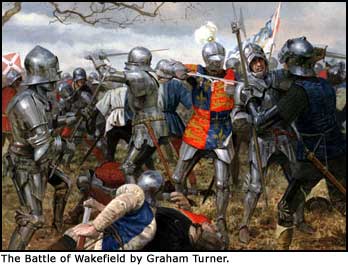
Battle of Wakefield saw the end of chivalric ransoms
The Battle of Wakefield saw the conflict take a grisly turn when captured nobles were executed instead of being customarily ransomed and these deaths made the battles extremely personal. The Battle of Ludford Bridge was a rare occasion in the Wars of the Roses where battle commanders, facing defeat, fled the battlefield to fight another day. The move by York to withdraw should be seen as calculated as he was hugely outnumbered following a large defection. Cowardice at Ludford should be viewed with caution as most of those who fled the battlefield - York, his son, the Earl of Rutland, Rutland's uncle, Salisbury and Salisbury's son, the Earl of Warwick, would later die in, or shortly after, battle.

The other escapee of Ludford was York's eldest son, Edward, who would claim the throne in 1461 after fighting amongst 50,000 men at the Battle of Towton that left 26,000 dead. Richard III would also charge into battle and refused to withdraw from the Battle of Bosworth after he was dismounted. Bosworth would ultimately be decided by those fighting under livery and maintenance as Sir William Stanley led his men at the crucial moment to attack the king.

The 30 years between the First Battle of St. Albans and Bosworth had periods of uneasy rest but the brutal battles and the twisted machinations would ensure that blood would soon be spilt and the long vaunted days of chivalry were over

Wednesday, April 1, 2015

A Fitting Tribute

Photo:Adam Hodges
April showers didn't deter visitors from queuing outside Leicester Cathedral today in order to pay their respects to Richard III's tomb. 

I joined the queue inside the nave but it soon stretched outside the door and around the front of the Cathedral in a crowd containing children out of school on their Easter holidays.
Cathedral visitors are welcomed with a quote from Poet Laureate Carol Ann Duffy
Visitors entering the cathedral were quickly reminded of last week's reinternment service with a quote from Poet Laureate Carol Ann Duffy's 'Richard' poem. It was at the reinternment service where Oscar nominee, and distant relative to Richard III, Benedict Cumberbatch, evocatively delivered Richard to the congregation.


Rays of sunlight shone through the Cathedral's stained glass windows on to today's congregation who gathered in the ambulatory to see the tomb. I was allowed to place my hand upon the Swaledale fossil-stone tomb but an usher prevented a couple from taking a 'selfie' beside Richard III's final resting place. The modest North Yorkshire stone is cut with a Christian cross and rests upon a dark Kilkenny-marble plinth etched with Richard III's name, life dates, White Boar emblem, royal coat of arms and motto. 
The deep-cut cross on Richard III's tomb (Photo: Adam Hodges)
The last time I had visited the Cathedral was to see Richard III's coffin a day before the reinterment service  and it was then adorned with a funeral pall, crown and Holy Bible. The funeral pall and crown are now on display in the Cathedral for visitors to examine the embroidery of artist Jacquie Binns depicting events in Richard III's lifetime and his discovery.
Richard III's funeral pall on display (Photo: Adam Hodges)
The crown was commissioned by historian John Ashdown-Hill and placed on the coffin by nine-year old brownie, Emma Chamberlain, during the Service of Repose on March 26 2015. A day which saw thousands, including myself, line the streets of Leicester to see Richard III return to the city.

Spotlights underneath the glass display-case in Leicester Cathedral made the rubies, emeralds, sapphires and plated-gold sparkle on the coronet which resembled the one Richard III adorned on Bosworth Battlefield almost 530 years ago.
The queue to view the tomb stretches outside the cathedral (Photo: Adam Hodges)
Richard III's reburial in late-March brought the world's spotlight on Leicester. The crowd outside the Cathedral and items in the Cathedral giftshop, such as a teddy of a Greyfriar who originally buried Richard III, indicate that many more from around the world will visit the king and his final resting place.

Tuesday, March 31, 2015

Profile - Edmund Plantagenet, Earl of Rutland 1443-1460


Edmund Plantagenent, Earl of Rutland, was second son to Richard, Duke of York, who fought alongside his father at the Battle of Wakefield.

BOY CHANCELLOR
Rutland was born in Rouen, France, in 17 May 1443 as the fifth child and second surviving son of the Duke of York and Cecily Neville. Edmund was granted the Earldom in 1446 and was tutored by Richard Croft at Ludlow Castle, his father's Shropshire estate. York showed his love to his eldest sons, Edward, Earl of March, and Rutland, by giving them green gowns as Easter gifts in 1454 despite York being busy at court becoming Protector of the Realm that spring.

York held the title Lieutenant of Ireland and appointed Rutland as Lord Chancellor of Ireland when his son was just eight-year-old. With Rutland underage, governing Ireland's coffers was tasked to Deputy Chancellors Edmund Oldhall, brother to York's Chamberlain, and then John Talbot, Earl of Shrewsbury. 

Following defeat at the Battle of Ludford Bridge on 12 October 1459, York took Rutland to Ireland via Devon and Wales, whilst leaving his wife and young children, Margaret, George and Richard, to the might of the royal army. The 16-year-old Rutland was able to study his father command order and respect in Ireland but soon discovered their stay in exile wouldn't last long after York discussed return plans with his nephew, Richard Neville, Earl of Warwick, at Waterford in spring 1460.

York and Rutland returned from Ireland on 8 September 1460, landing in north Wales, and traveled to Ludlow and Hereford. It was at Hereford where Rutland met up with his mother and younger siblings but he followed his father's march south to London. York's march was signaled with the flying of the royal standard as if it was his own and York proclaimed his right to the throne by placing a hand upon it on 10 October 1460.

York's actions were derisive and alienated his supporters including Warwick and his father, Richard Neville, Earl of Salisbury. An incensed Warwick challenged York in the pretender's Westminster apartments but a brave and loyal Rutland came to his father's defence by saying to Warwick, "Fair Sir, be not angry, for you know that we have the true right to the crown, and that my lord and father must have it."   
Rutland clashed with the Earl of Warwick following York's public claim to the throne
Rutland's older brother Edward, who had escaped Ludford Bridge to Calais with Warwick, looked to calm the atmosphere by saying to Rutland, "Brother, vex no man, for all shall be well." Edward left the apartments with Warwick and Rutland stayed by his father's side. Later that month, Parliament passed an Act of Accord that decreed York and his heirs would inherit the throne after Henry VI, despite the fact that the king had a son, Prince Edward of Westminster.

Rutland accompanied his father's march north from London on 9 December 1460 after York and Salisbury's northern estates had been looted by Lancastrian forces. After a skirmish with the troops of Henry Beaufort, 3rd Duke of Somerset, at Worksop, Nottinghamshire, York's army reached Sandal Castle near Wakefield on 21 December 1460.

BATTLE
The Battle of Wakefield on 30 December 1460 saw York lead his men out of Sandal Castle in search for a foraging party who had earlier left under the  apparent safety of a Christmas truce. The Lancastrian forces were led by Somerset, Henry Percy, Earl of Northumberland, and Lord John Clifford, whose fathers had all died at First Battle of St. Albans five years previously.

York was ambushed on Wakefield Green and commanded his son to flee the battle to meet up with his brother, Edward, who was building up reinforcements in the Welsh marches. Under protest, Rutland left the battlefield and made it as far as Wakefield Bridge before he was captured. Clifford met his captive on the bridge and was urged by Rutland's tutor, priest Robert Aspell to ransom Rutland, "for he is the Prince's son, and peradventure may do you good hereafter." Clifford replied in anger, "By God’s blood, thy father slew mine and so will I do thee and thy kin,” before stabbing Rutland to death.
Rutland begs Sir John Clifford for mercy
The decapitated head of Rutland would soon join the heads of his father and uncle on spikes atop of Micklegate Bar in York. The bodies of Rutland and York were hastily buried in Pontefract Priory until Edward, now King Edward IV, reinterred them in the family vault at Fotheringhay Castle on 30 January 1466.