Showing posts with label Lancastrian Victory. Show all posts

Friday, March 20, 2015

Battle of Ludford Bridge 1459

Ludford Bridge
Henry VI's Lancastrian army had their first victory of the Wars of the Roses with a bloodless battle at Ludford Bridge on 12 October 1459.

Richard Neville, Earl of Salisbury, victorious at the Battle of Blore Heath, linked up with his son, Earl of Warwick, and the Duke of York at Worcester on 10 October, 1459. The Yorkist commanders sent word to Henry VI that they had sworn an oath of loyalty to the king but decried the "evil councillors" surrounding him. The king responded by saying he would issue pardons to those who would join him within six days.

York retreated towards Ludlow and took up a fortified position near Ludford, Shropshire, by excavating a ditch on the opposite side of the River Teme from Ludlow and aimed cannons on Ludford.

Henry VI's presence at Ludford unsettled Warwick's contingency of 600 men from the Calais garrison who were unwilling to fight against their king. Word spread through the camp of the king's renewed wish for royal pardons for those who joined him and the Calais commander, Andrew Trollope, changed allegiances.

York reviewed the need to fight as he was severely outnumbered five to one with the royal forces totaling 30,000 men compared to York's 5,000. Under the cover of darkness, the Yorkist commanders abandoned their army and fled. York took his second son, Edmund, Earl of Rutland, to Ireland whilst Warwick, Salisbury and York's eldest son, Edward, Earl of March, fled to Calais.
Ludlow Market depicted by Louise Raynor
At dawn the next day the leaderless Yorkist troops knelt in submission before Henry VI and were pardoned. York left behind his wife Cecily, his two younger sons, George and Richard, and his youngest daughter, Margaret. The Duchess of York and her young children were found standing at Ludlow Market Cross and were placed in the care of Cecily's sister, Anne. Anne was married to Humphrey Stafford, 1st Duke of Buckingham, and Buckingham kept Margaret of Anjou updated on the Nevilles' well-being. 

The Yorkist commanders may have been in exile but both York and Warwick were able to build on the military and financial support of Ireland and Calais. The royal couple responded in December 1459 by forfeiting York's, Salisbury's and Warwick's lands, titles and inheritance in an act of attainder. The Yorkist commanders would return to England in 1460 to reclaim their titles and power from the crown.

Friday, March 13, 2015

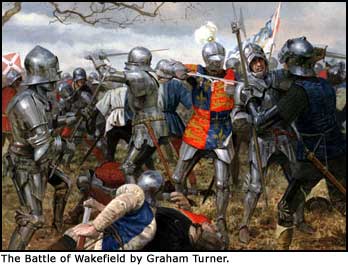
Battle of Wakefield 1460


The Battle of Wakefield, on December 30 1460, was a pivotal clash in the Wars of the Roses that resulted in the deaths of key Yorkist commanders and serves as the opening for Loyalty Binds Me.

BACKGROUND
Richard Plantagenet, 3rd Duke of York, family patriarch and Lord Protector of England, moved north from London on December 9th 1460 to counter the growing Lancastrian forces. York was joined by his son, Edmund, Earl of Rutland, and his brother-in-law, Richard Neville, Earl of Salisbury. London was guarded by Salisbury's son, Richard Neville, Earl of Warwick, and York's eldest son, Edward, Earl of March, was dispatched to Wales to quell Lancastrian support.
York's progress north was slowed by widespread flooding and this allowed the Lancastrians forces to grow in the north. The northern Lancastrian army were led by Henry Percy, Earl of Northumberland, Lord John Clifford and Lord Thomas Ros. Reinforcements came from the West Country with men commanded by Henry Beauford, Duke of Somerset, and Thomas Courtenay, Earl of Devon, to amass an army of over 15,000 men gathered around Kingston-upon-Hull. A substantial amount encamped at Pontefract and began pillaging York's and Salisbury's nearby estates. Northumberland, Clifford and Somerset were ready to exact revenge on those who had killed their fathers five years previously at the First Battle of St. Albans.
York's force of 8,000 men arrived in Wakefield on 21 December after earlier skirmishes in Nottinghamshire. The gates of Wakefield were closed to York and he took residence nearby at Sandal Castle. The Lancastrian army encircled the castle and a Christmas truce was agreed upon with a battle commencing on the Feast of Epiphany, January 6. York sent word to his son in Wales to bring reinforcements, whilst his men at Sandal Castle grew hungry after depleting their provisions over Christmas. York decided to send out a foraging party on December 30 to get more provisions but they never returned.  

BATTLE
York took his men down from Sandal Castle later that day and were soon ambushed on Wakefield Green. As York engaged the Lancastrians to his front, others attacked him from the flank and rear, cutting him off from the castle and the scene was later described by Edward Hall “like a fish in a net, or a deer in a buckstall; so that he manfully fighting was within half an hour slain and dead, and his whole army discomforted."
Ruins of Sandal Castle
York's army was surrounded and destroyed with the dead numbering 2,500 Yorkist and 200 Lancastrians. York was killed in the battle but instructed his son to flee to Wales before dying. Rutland was soon captured and killed on Wakefield Bridge. Clifford cried out “By God’s blood, thy father slew mine and so will I do thee and thy kin” as he stabbed Rutland to death.
Salisbury, whose son Sir Thomas Neville died in battle, escaped the battlefield but was captured during the night, and was taken to the Lancastrian camp. Although the Lancastrian nobles had been prepared for Salisbury to ransom himself, he was dragged out of Pontefract Castle and beheaded by local commoners who felt animosity towards their former harsh overlord.
The heads of York, Rutland and Salisbury were later put on spikes on Micklegate Bar, the western gate into the city of York. The Duke of York was ridiculed with a a paper crown on his head and a sign around his spike that stated "Let York overlook the town of York."
Wakefield brought the end of York's claim to the throne but this was quickly taken up by his son, and future King, Edward VI. Wakefield set a grisly precedent in that after every following battle in the Wars of the Roses, the victorious side would eliminate any opposing leaders, making the struggle more bitter and revenge driven.