Showing posts with label 1459. Show all posts

Friday, March 20, 2015

Battle of Ludford Bridge 1459

Ludford Bridge
Henry VI's Lancastrian army had their first victory of the Wars of the Roses with a bloodless battle at Ludford Bridge on 12 October 1459.

Richard Neville, Earl of Salisbury, victorious at the Battle of Blore Heath, linked up with his son, Earl of Warwick, and the Duke of York at Worcester on 10 October, 1459. The Yorkist commanders sent word to Henry VI that they had sworn an oath of loyalty to the king but decried the "evil councillors" surrounding him. The king responded by saying he would issue pardons to those who would join him within six days.

York retreated towards Ludlow and took up a fortified position near Ludford, Shropshire, by excavating a ditch on the opposite side of the River Teme from Ludlow and aimed cannons on Ludford.

Henry VI's presence at Ludford unsettled Warwick's contingency of 600 men from the Calais garrison who were unwilling to fight against their king. Word spread through the camp of the king's renewed wish for royal pardons for those who joined him and the Calais commander, Andrew Trollope, changed allegiances.

York reviewed the need to fight as he was severely outnumbered five to one with the royal forces totaling 30,000 men compared to York's 5,000. Under the cover of darkness, the Yorkist commanders abandoned their army and fled. York took his second son, Edmund, Earl of Rutland, to Ireland whilst Warwick, Salisbury and York's eldest son, Edward, Earl of March, fled to Calais.
Ludlow Market depicted by Louise Raynor
At dawn the next day the leaderless Yorkist troops knelt in submission before Henry VI and were pardoned. York left behind his wife Cecily, his two younger sons, George and Richard, and his youngest daughter, Margaret. The Duchess of York and her young children were found standing at Ludlow Market Cross and were placed in the care of Cecily's sister, Anne. Anne was married to Humphrey Stafford, 1st Duke of Buckingham, and Buckingham kept Margaret of Anjou updated on the Nevilles' well-being. 

The Yorkist commanders may have been in exile but both York and Warwick were able to build on the military and financial support of Ireland and Calais. The royal couple responded in December 1459 by forfeiting York's, Salisbury's and Warwick's lands, titles and inheritance in an act of attainder. The Yorkist commanders would return to England in 1460 to reclaim their titles and power from the crown.

Battle of Blore Heath 1459

England's uneasy period of peace since the First Battle of St. Albans came to end on 23 September 1459 at the Battle of Blore Heath in Staffordshire.

BACKGROUND
Queen of England, Margaret of Anjou, had been growing in animosity towards Richard, Duke of York, and his supporters, Earl of Salisbury and Earl of Warwick. The Yorkist commanders were spread across the land with York at Ludlow in Shropshire, Salisbury at Middleham,Yorkshire and Warwick in Calais. 

Troops were being mustered on both sides and Salisbury took his men south to link up with York at Ludlow. The royal army was moving to Ludlow from Nottingham but Anjou, hearing of Salisbury's movements, instructed James Tuchet, Lord Audley, to intercept.

BATTLE
Audley chose the open ground of Blore Heath to press home his advantage of 10,000 men and cavalry. Salisbury took up defensive positions by digging a trench to his rear and fortified the front line with stakes. Audley took up position behind a steep, wide and fast-flowing stream that was out of range of Salisbury's archers.

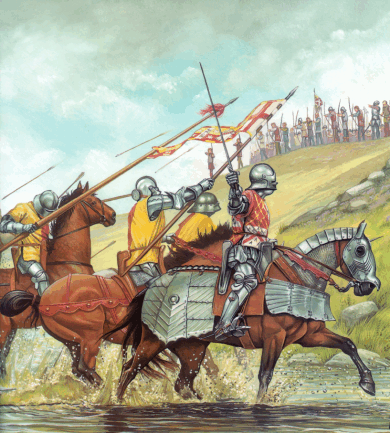
Salisbury prompted Audley into a cavalry charge by ordering a portion of his line to retreat. Audley fell into the trap as Salisbury ordered his men to return and attack the cavalry crossing the stream. The Lancastrian infantry successfully crossed the stream in a second attack and a fierce melee ensued.
Lord Dudley leads the Lancastrian attack
Audley died in the fighting and his command was left to John Sutton, Lord Dudley, who led 4,000 infantrymen into the third and final wave. Dudley's cause soon deteriorated when 500 of his own men joined the enemy and attacked the Lancastrians. Dudley's men soon fled the battle and they were cut down by Salisbury's men. 

Salisbury, despite having half of the men, was able to take advantage of the land and his military tactics, to kill 2,000 Lancastrians to the loss of his 1,000 men. But Salisbury was aware of an approaching royal army, with Anjou five miles away at Eccleshall and Henry VI 10 miles away.

Salisbury showed further ingenuity in his undetected retreat from Blore Heath when he instructed a friar to fire the remaining battlefield artillery throughout the night. The royal forces of 15,000 men advanced to Blore Heath and were greeted the next morning by the lone friar. The friar replied to Lancastrian demands of why he stayed on the battlefield all night by saying he was "afraid to leave it."

York would later met up with Salisbury and Warwick at Worcester to prepare for a fight with the Lancastrians that came at Ludford Bridge on 12 October 1459.