Showing posts with label Battle of Ludford Bridge. Show all posts

Friday, April 10, 2015

Profile - Cecily Neville Part 1 1415-1460


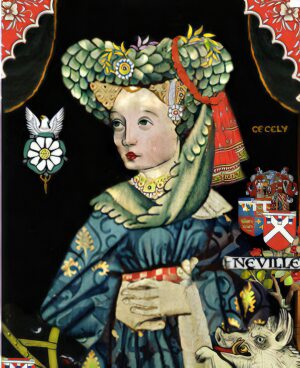
The 80 years of Cecily Neville's life would see her family's power rise, fall and rise again as she became wife of a pretender to the English throne, mother to the two Yorkist kings, and grandmother to the first Tudor queen. Cecily, however, would tragically outlive her husband and all of their 13 children.

'ROSE OF RABY'
Cecily Neville was born on 3 May 1415 at Raby Castle in Durham as youngest daughter to parents Ralph Neville, 1st Earl of Westmorland, and Joan Beaufort with Cecily's good looks rewarded with the sobriquet 'Rose of Raby'. Her maternal grandparents were the English prince, John of Gaunt, 1st Duke of Lancaster, and Katherine Swynford. The family connections to the Beauforts would see Margaret Beaufort, mother of Henry Tudor, as Cecily's second cousin.

Ralph Neville had become the royal warden of Richard, Duke of York after York's father, Richard of Conisburgh,  was condemned to death in 1415, and the young duke arrived at Raby Castle in December 1423 to live with the Nevilles. Cicely's father betrothed her to York in October 1424 at the expense of 3,000 marks to the crown to release York from his wardship. Cicely was 14 years-old and York was 18 when the couple married in October 1429 and would remain married for 31 years with Cicely bearing 13 children, seven of whom survived childhood.
Fotheringhay Castle in Northamptonshire was a favourite family residence
York's vast estates would see Cecily live in Ludlow Castle in Shropshire, Fotheringhay Castle in Northamptonshire and Baynard's Castle in London. The contented marriage saw Cicely follow her husband to France and Ireland during York's time in office. Rouen in France would see the births of Cecily's eldest living sons Edward and Edmund and second living daughter, Elizabeth, between 1443 and 1444.The third living son, George, was born in 1449 in Dublin, Ireland and Cicely would bear children across 17 years and daughters Anne, Margaret and youngest son Richard were all born at Fotheringhay Castle. This would indicate that Fotheringhay Castle was the family's favourite residence.

Cicely was renowned for her piety, attending eight services a day, and this would make a mockery of later Lancastrian propaganda that slandered her as an adulteress with the rumour that Edward IV was born a bastard to Blaybourne, a French archer. The Duchess would vehemently protest against this slander and Cicely's own pride and temper would bring her the nickname 'Proud Cis'.

LADY PROTECTOR
The Duke and Duchess of York attended the wedding of King Henry VI and Margaret of Anjou in May 1445 and the queen would show court nepotism at Duke of York's expense. Cecily's first cousin, Edmund Beaufort, 2nd Duke of Somerset, replaced York as Lieutenant of France but wasn't able to emulate York's time in office as France reclaimed Normandy along the English Channel coast.

Southern England was fearful of a French invasion and Jack Cade led an unsuccessful rebellion against the king and his "friends". Cade appealed to York supporters by calling himself Mortimer after York's ancestors and demanded that Henry VI removed his friends or the king would be replaced by York if this wasn't done.

York had no association with Cade but the rebellion caused many at court to ponder whether York was going to claim the throne when he travelled from Ireland to England in September 1450. York protested his allegiance to the king and demanded Somerset's arrest over France. Henry VI initially agreed but the queen intervened and duly promoted her court favourite to Captain of Calais. York was in turn given a much the lower ranked title of Justice of the Forest South of the Trent. 
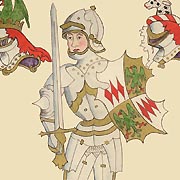
Cecily's nephew, Earl of Warwick, originally supported his Beaufort relatives
A frustrated York returned to his estates. Cecily, pregnant with Richard, may have encouraged York to reassert his power and birthright which led to her husband gathering troops and marching on London but he would find the capital gates locked. York reached Dartford in Kent and faced off against the royal troops including Cecily's brother, Richard Neville, Earl of Salisbury and his son, Richard Neville, Earl of Warwick. York looked for peace and demanded Somerset's arrest but the queen intervened once again.  

Margaret of Anjou was incensed to see Somerset being carried away in chains and a showdown in the royal tent saw Queen Margaret demand York's arrest instead. The Duke returned to London being paraded like a prisoner at the head of the royal party.
Cecily and the queen met at the shrine of Our Lady of  Walsingham
Cecily came to her husband's defence and the queen agreed to hear the Duchess' pleas for clemency at the shrine of Our Lady of Walsingham in Norfolk. The Duchess would later write to the queen and praised the meeting where Cecily surmised that her husband's "infinite sorrow and unrest of heart" caused him to be "estranged from the grace and benevolent favour" of the king. Cecily's plan worked as the queen stopped pursuing York's imprisonment but York he was publicly humiliated at St. Paul's Cathedral where he swore an oath of allegiance to the king. 

York was mindful of his own father's fate and withdrew to his estates once again to spend time with the family. York also provided much needed support to his in-laws in their land disputes with Somerset and Neville's northern rivals, the Percies

The royal couple welcomed their long-awaited heir in 1453 when the queen gave birth to Prince Edward. Henry VI was unable to acknowledge his son's existence after the king descended into a severe bout of mental illness following England's heavy loss at the Battle of Castillon. England needed a leader as York returning to court and was elected Lord Protector in March 1454. York brought much needed order and appointed his brother-in-law, Salisbury, as Chancellor and his nephew, Warwick, became Captain of Calais.

York's control of government didn't last long as Henry VI regained his senses during Christmas 1454 and Somerset, imprisoned in the Tower by York, was released. Parliament was to reconvene in Leicester in May 1455 and York saw this as a ruse by the queen to arrest him. Cecily's brother and nephew joined her husband and intercepted the royal army at the First Battle of St. Albans where Somerset was killed and the king captured. 
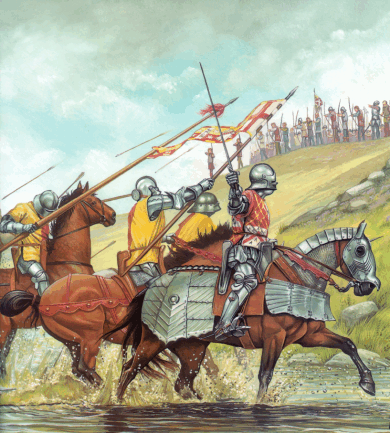
Cecily's brother successfully fought off a Lancastrian charge at Blore Heath
York would return as Lord Protector after Henry VI relapsed towards the end of 1455 and a rejuvenated king kept Warwick on as Captain of Calais after Henry VI recovered in 1456. The queen would now target Cecily's nephew with charges of piracy and a suspected murder plot against Warwick, further antagonising the Yorkist and Lancastrian divide. York and the Nevilles gathered troops and met at Ludlow in October 1459 after Salisbury had defeated a portion of the royal army at the Battle of Blore Heath en-route to Shropshire.  

DESERTED
Henry VI led his troops to just south of Ludlow and offers of royal pardons proved too tempting to York's army as Warwick's Calais troops commanded by Andrew Trollope, defected. The Battle of Ludford Bridge proved to be bloodless after York abandoned his army and fled the battlefield. York took Edmund, now Earl of Rutland, to Ireland whilst Edward, now Earl of March, joined his uncle and cousin in fleeing to Calais. 
Cecily and her children were captured in Ludlow Market Square
Cecily was left to defend Ludlow with her three youngest children and they were discovered by the Lancastrian army at Ludlow Market Cross. Cecily pleaded for clemency once again and was placed under the care of her sister Anne, Duchess of Buckingham, and her husband, the Lancastrian commander, Henry Stafford, Duke of Buckingham.

The Duchess of York and her youngest children stayed with the Buckinghams at Tunbridge Castle in Kent and it's close proximity to Calais would have allowed possible secret communications between Cecily and her eldest son. Cecily, like seven years before, defended her husband at court and asked for a royal pardon. She was unsuccessful in preventing her husband, brother and nephew being given an Act of Attainder which forfeited all their lands and titles. The queen, possibly remembering the time at Walsingham, may have taken pity on Cecily and the defunct-Duchess was granted £600 a year to support herself and her children.
Cecily resided in London at Banyard's Castle before York returned to England
Cecily's nephew and husband met in Ireland during the spring of 1460 to plan a return to England and Warwick, Salisbury and Edward landed in Sandwich on the Kent coast in June 1460. Salisbury held London and welcomed his sister to the capital as she took up residence in Banyard's Castle following the Yorkist victory at the Battle of Northampton. Warwick and Edward faced the royal troops in July 1460 near Northampton where treachery would allow March to take the vanguard and breach Lancastrian defences. The Lancastrian commanders were taken by surprise once the Yorkists were behind the front-lines and Buckingham would die defending the king who would once again be captured and brought back to London.

QUEEN-IN-WAITING
York returned to England on 8 September 1460 and immediately sent word to Cecily for the married couple to meet at Hereford. Cecily travelled to the west country in a charriot or litter dressed in blue velvet and carried by eight horses. York likely discussed his intentions of claiming the throne with Cicely at Hereford and, wIth Margaret of Anjou fleeing to Scotland, Cecily acted every part of a queen as she carried the royal arms during her husband's procession to London.
The Duke and Duchess of York reunited in Hereford before proceeding to London
Her husband's bold move in claiming the throne from Henry VI got little support in Parliament including Warwick and Salisbury who weren't aware of York's plan. A compromise in Parliament was struck in late October 1460 with an Act of Accord declaring York as heir-apparent and disinherited Prince Edward. York and his heirs would now take the throne once Henry VI died and Cecily became a queen-in-waiting. 

Word soon spread that Margaret of Anjou was courting Scottish support and the Percies were raiding the Yorkshire estates of York and Salisbury. York sent Edward to the Welsh Marches to rally the troops, Warwick held London and York took Edmund and Salisbury north to face the Lancastrians. Cecily gave her husband and son a fond farewell in early December 1460 and expected to welcome their return in the New Year. This never happened and Cecily was devastated when she heard of the deaths of her husband, second son and eldest brother at the Battle of Wakefield.

Thursday, April 2, 2015

Wars of the Roses Weaponary and Tactics


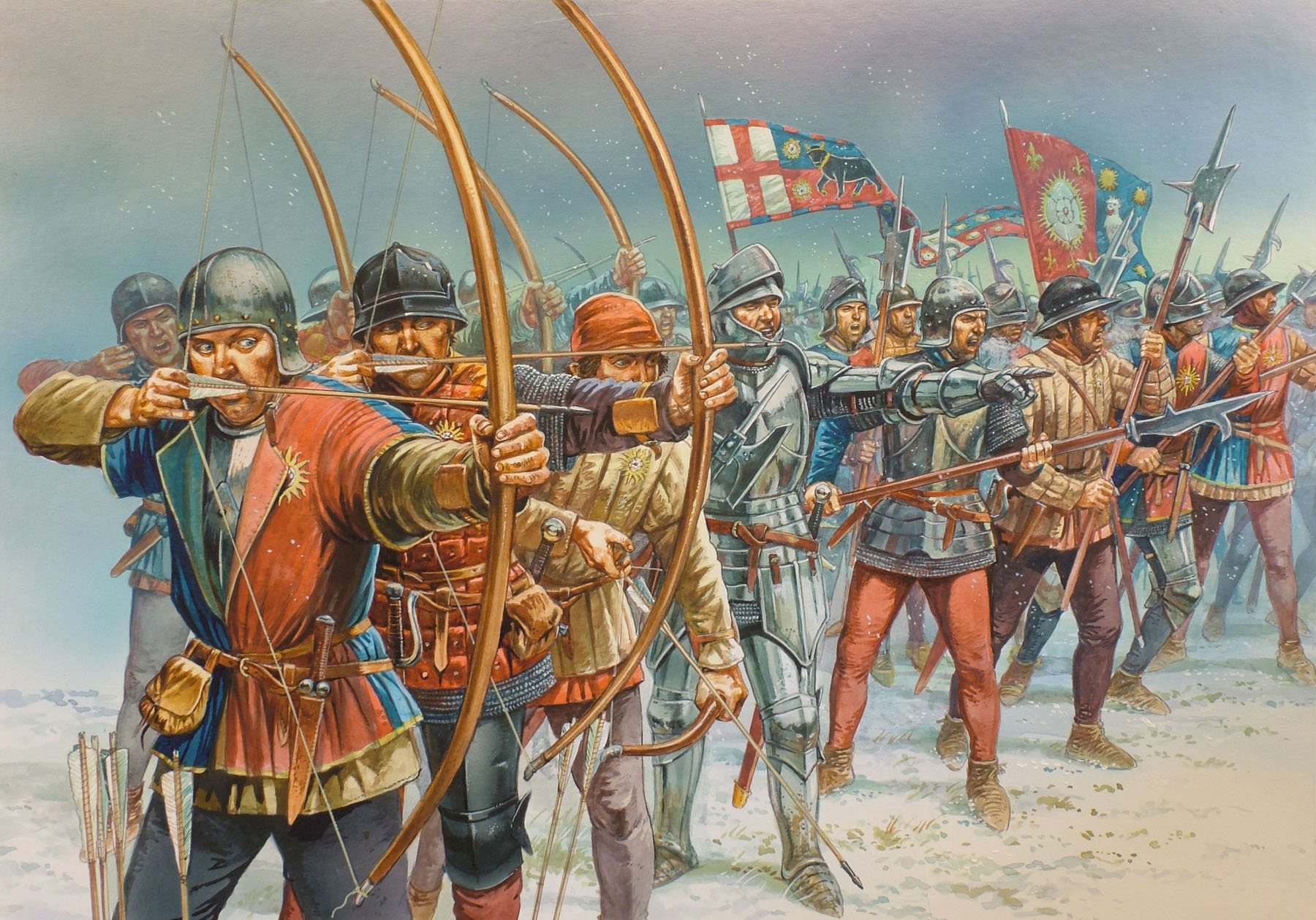
The wars raged across 15th Century England made it essential for forces to be properly armed and protected.

ARMOUR
Men-at-arms in the thick of the action were fitted with heavy armour with a breast-plate underneath a leather brigandine or chain-mail hauberk. Attached to the breastplate were the plate armoured gorget around the neck, pauldron over the shoulders, couter over the elbows, vambraces over the forearms, tassets over the thighs and culet over the lower back. Added protection was found with plate-armoured gauntlet gloves and knights wore lance rests attached to the breast plate to steady their lances for a firmer blow.
Horses were also glad in plate armour
The main disadvantage of heavy armour was the lack of mobility and the quick-moving infantry wore a mail shirt over a padded aketonmail, with added munitions plate covering the most important body parts.  Light armour mostly consisted of padded cloth and leather with the archer's bracer providing a leather armguard to protect the fletching of an arrow. 
A Richard III re-enactor wears a crowed sallet helmet
Helmets also varied in design depending on how much protection was needed. Heavy helmets were made from steel plate, covered the head with visors on bascinets, armets, sallets and close helmets. Richard III was likely wearing a crowned sallet when he charged Henry Tudor at the Battle of Bosworth.

Medium helmets were made of steel, but didn't protect the entire head like the visor-less barbute helmet. Light helmets were usually caps made of cloth and leather but archers preferred the wide-brimmed steel kettle hats for greater field of vision and to shield their eyes from the sun. Helmets were often customised with different colours, plumes, coifs and bevors. 
Archers wore kettle helmets to shield their eyes from the sun

COMBAT WEAPONS
The advancements in protective armour led to the development of the longsword which allowed a double-handed grip with the sword's longer hilt. The finest swords of the era were stamped with a German Passau wolf and the unusually hard Toledo steel forged in Spain. Daggers were often used as a side-arm and the small, sharp bladed wound on top of Richard III's skull showed that they were used as execution weapons, with two hands likely used to push the pommel into Richard III's skull.

Other weapons used by men-at-arms included hammers, maces, axes, spears and pole arms like the halberd. The halberd was inexpensive to produce and very versatile in battle as the hook and axe head were able to pull horsemen to the ground. The large hole at the base of Richard III's skull shows that a halberd likely sliced the back of the king's head and struck the fatal blow. The bill hook was also effective at bringing down a horseman with the pronounced hook able to find a chink in the knight's armour. 
A halberd likely struck the fatal blow to Richard III
Men on horseback attacked in triangular formations, with the most heavily armored knights at the front. They defended themselves with shields and attacked with a wooden lance that would shatter upon impact. Richard III was the head of a triangular formation charging towards Henry Tudor and his lance shattered into the helmet of Tudor's standard bearer, Sir William Brandon.

RANGED WEAPONS
The longbow gained it's notoriety at the Battle of Agincourt with a fast reload, accurate archers, armour-piercing bodkin heads and light-weight bowstaves. Compulsory longbow training was enforced in 1470 and many of the fragile yew bowstaves would often break and needed replacing. This led to a shortage in yew and this was overcome by Richard III increasing the tax on ships arriving in English ports to 10 bowstaves per tun in cargo, up from 4 bowstaves decreed in the Statue of Westminster 1472.
Longbowmen in action at the Battle of Towton (Graham Turner)
An effective longbowman took years of strength and skill training whilst a crossbow could be used effectively after a week's training. The crossbow was more powerful than a longbow thanks to a greater release of kinetic energy but it was more inaccurate and had a slower shooting rate than an average longbow. The archers took central position in battle formations and usually engaged the enemy before a main assault of mounted knights. Crossbowmen were also utilised in counterattacks to protect their infantry.
Cannon fires at a Battle of Tewkesbury festival
Arrows would eventually be replaced by gunpowder and shot in the coming centuries. The Wars of the Roses saw artillery like culverins used to supplement infantry attacks and bombards brought siege to Bamburgh Castle in 1464. Transporting artillery from camp-to-camp provided to be cumbersome and firearms, such as hand culverins, hand bombards and hand cannons developed.


TACTICS
In the early 1450s the act of gathering troops and marching to battle didn't usually result in combat as Duke of York's standoff at Dartford showed. Henry VI may have been expecting the same when he garrisoned the wall-less town of St. Albans in 1455 but York decided to end hours of stalemate by launching the First Battle of St. Albans.

A commander would line his troops into three 'battles' - the vanguard leading the attack, the main in the middle, and the rearguard often holding back reserves. Archers had previously launched the opening salvo into opposing infantry but by the mid-1400s this had developed into a stalemate of opposing bowmen fighting each other. Men-at-arms would either lead the vanguard on foot (Battle of Northampton) or on horseback (Battle of Blore Heath). 
Lord Audley leads a cavalry charge at Blore Heath
Armies made best use of their terrain and would fortify their positions by using bodies of water and marshland, digging trenches and setting up wooden spikes to deter on-coming cavalry. Deception was used effectively by Earl of Salisbury at Blore Heath by removing his soldiers from the front line to give the impression of retreat to Lord Audley. Audley was lured into taking his cavalry over a stream and was unable to avoid Salisbury's returning men.

The rank-and-file troops were gathered by their lords or knights and served in all of their disputes wearing the lord's ‘livery’ and fought under their banner. In return, the lord ‘maintained’ their tenants' rights and claims. This ‘livery and maintenance’ soon developed into ‘bastard feudalism’ as cash rewards replaced traditional land gains. 

The level of professionalism varied amongst the troops who would often flee the battlefield or surrender unarmed when the fight was lost. The Wars of the Roses was mainly a dispute between noble families and the rank-and-file were spared the bloodshed of their noble commanders whose heavy armour would hinder them escaping a melee.  
Battle of Wakefield saw the end of chivalric ransoms
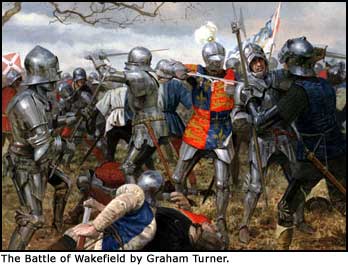
The Battle of Wakefield saw the conflict take a grisly turn when captured nobles were executed instead of being customarily ransomed and these deaths made the battles extremely personal. The Battle of Ludford Bridge was a rare occasion in the Wars of the Roses where battle commanders, facing defeat, fled the battlefield to fight another day. The move by York to withdraw should be seen as calculated as he was hugely outnumbered following a large defection. Cowardice at Ludford should be viewed with caution as most of those who fled the battlefield - York, his son, the Earl of Rutland, Rutland's uncle, Salisbury and Salisbury's son, the Earl of Warwick, would later die in, or shortly after, battle.

The other escapee of Ludford was York's eldest son, Edward, who would claim the throne in 1461 after fighting amongst 50,000 men at the Battle of Towton that left 26,000 dead. Richard III would also charge into battle and refused to withdraw from the Battle of Bosworth after he was dismounted. Bosworth would ultimately be decided by those fighting under livery and maintenance as Sir William Stanley led his men at the crucial moment to attack the king.

The 30 years between the First Battle of St. Albans and Bosworth had periods of uneasy rest but the brutal battles and the twisted machinations would ensure that blood would soon be spilt and the long vaunted days of chivalry were over

Tuesday, March 31, 2015

Profile - Edmund Plantagenet, Earl of Rutland 1443-1460


Edmund Plantagenent, Earl of Rutland, was second son to Richard, Duke of York, who fought alongside his father at the Battle of Wakefield.

BOY CHANCELLOR
Rutland was born in Rouen, France, in 17 May 1443 as the fifth child and second surviving son of the Duke of York and Cecily Neville. Edmund was granted the Earldom in 1446 and was tutored by Richard Croft at Ludlow Castle, his father's Shropshire estate. York showed his love to his eldest sons, Edward, Earl of March, and Rutland, by giving them green gowns as Easter gifts in 1454 despite York being busy at court becoming Protector of the Realm that spring.

York held the title Lieutenant of Ireland and appointed Rutland as Lord Chancellor of Ireland when his son was just eight-year-old. With Rutland underage, governing Ireland's coffers was tasked to Deputy Chancellors Edmund Oldhall, brother to York's Chamberlain, and then John Talbot, Earl of Shrewsbury. 

Following defeat at the Battle of Ludford Bridge on 12 October 1459, York took Rutland to Ireland via Devon and Wales, whilst leaving his wife and young children, Margaret, George and Richard, to the might of the royal army. The 16-year-old Rutland was able to study his father command order and respect in Ireland but soon discovered their stay in exile wouldn't last long after York discussed return plans with his nephew, Richard Neville, Earl of Warwick, at Waterford in spring 1460.

York and Rutland returned from Ireland on 8 September 1460, landing in north Wales, and traveled to Ludlow and Hereford. It was at Hereford where Rutland met up with his mother and younger siblings but he followed his father's march south to London. York's march was signaled with the flying of the royal standard as if it was his own and York proclaimed his right to the throne by placing a hand upon it on 10 October 1460.

York's actions were derisive and alienated his supporters including Warwick and his father, Richard Neville, Earl of Salisbury. An incensed Warwick challenged York in the pretender's Westminster apartments but a brave and loyal Rutland came to his father's defence by saying to Warwick, "Fair Sir, be not angry, for you know that we have the true right to the crown, and that my lord and father must have it."   
Rutland clashed with the Earl of Warwick following York's public claim to the throne
Rutland's older brother Edward, who had escaped Ludford Bridge to Calais with Warwick, looked to calm the atmosphere by saying to Rutland, "Brother, vex no man, for all shall be well." Edward left the apartments with Warwick and Rutland stayed by his father's side. Later that month, Parliament passed an Act of Accord that decreed York and his heirs would inherit the throne after Henry VI, despite the fact that the king had a son, Prince Edward of Westminster.

Rutland accompanied his father's march north from London on 9 December 1460 after York and Salisbury's northern estates had been looted by Lancastrian forces. After a skirmish with the troops of Henry Beaufort, 3rd Duke of Somerset, at Worksop, Nottinghamshire, York's army reached Sandal Castle near Wakefield on 21 December 1460.

BATTLE
The Battle of Wakefield on 30 December 1460 saw York lead his men out of Sandal Castle in search for a foraging party who had earlier left under the  apparent safety of a Christmas truce. The Lancastrian forces were led by Somerset, Henry Percy, Earl of Northumberland, and Lord John Clifford, whose fathers had all died at First Battle of St. Albans five years previously.

York was ambushed on Wakefield Green and commanded his son to flee the battle to meet up with his brother, Edward, who was building up reinforcements in the Welsh marches. Under protest, Rutland left the battlefield and made it as far as Wakefield Bridge before he was captured. Clifford met his captive on the bridge and was urged by Rutland's tutor, priest Robert Aspell to ransom Rutland, "for he is the Prince's son, and peradventure may do you good hereafter." Clifford replied in anger, "By God’s blood, thy father slew mine and so will I do thee and thy kin,” before stabbing Rutland to death.
Rutland begs Sir John Clifford for mercy
The decapitated head of Rutland would soon join the heads of his father and uncle on spikes atop of Micklegate Bar in York. The bodies of Rutland and York were hastily buried in Pontefract Priory until Edward, now King Edward IV, reinterred them in the family vault at Fotheringhay Castle on 30 January 1466.

Friday, March 27, 2015

Profile - Richard Neville, Earl of Salisbury 1400-1460

Richard Neville, 5th Earl of Salisbury, was a key Yorkist supporter in the beginning of the Wars of the Roses, and was also brother-in-law to Richard, Duke of York.

WARDEN OF THE NORTH
The Earl of Salisbury was born in 1400 at Raby Castle in County Durham and was the eldest son of Ralph de Neville, 1st Earl of Westmorland, and Joan Beaufort, daughter of John of Gaunt and Katherine Swynford. Salisbury's father was responsible for the wardship of the orphaned Duke of York, and Ralph Neville betrothed the wealthy duke to his youngest daughter, Cecily.

Richard Neville was married to Alice Montacute, daughter and heiress of Thomas Montacute, the Earl of Salisbury, sometime before February 1421 when they attended the coronation of Queen Catherine of Valois as a married couple. Ralph Neville died in 1425 and Richard inherited the family residence of Middleham Castle with the Earldom of Salisbury coming three years later when Alice's father died.
Middleham Castle - Seat of Neville Power
Salisbury became a commander at the age of 20 when appointed Warden of the West March on the Scottish border and was rewarded by Henry V in his appointment of Justice of the Peace in Cumberland, Westmoreland, and Durham. Salisbury began to frequent the royal court and accompanied the young King Henry VI to France for his coronation in 1431 and his fealty was rewarded by becoming Warden of the East March on the Welsh border.

In 1436, Salisbury resigned from both posts and accompanied York, the newly appointed Lieutenant of France, with 1,300 men-at-arms and archers to protect English lands on the French domain. Salisbury returned the following year and was repaid with a seat on the King's Council whilst also resuming the Wardenship of the West March. The wardenship caused resentment with the Percy family, who had lands just south of the Scottish border in Northumberland.

The Percys were aggrieved when Salisbury recruited men in their Cumberland and Westmorland estates and the Percys flouted Salisbury's rule during the Battle of Sark against the Scots in 1448. Salisbury was to feel the wrath of the Percys up close on 24 August 1453 when Thomas Percy, Lord Egremont, attacked Salisbury at Heworth Moor, outside York, on the journey home to Sheriff Hutton. Salisbury was returning from the wedding of his son Thomas and he fought off Egremont's men unscathed.

YORKIST
Salisbury's eldest son became Richard Neville, 16th Earl of Warwick when he married the Warwick heiress Anne Beauchamp in 1449. Warwick was to exceed his father in lands, wealth and titles but remained loyal and Salisbury would take a high place in the Privy Council after Henry VI's mental breakdown. 

During the king's illness, York was elected Protector of the Realm on 27 March 1454 and assigned his brother-in-law as Chancellor. Salisbury wasn't able to tackle government overspending for long as York's influence diminished when Henry VI regained his sense on Christmas Day 1454. York and Warwick's enemy, Edmund Beaufort, 2nd Duke of Somerset, was released from the Tower of London and Salisbury resigned as Chancellor in 1455.
Henry VI's return to health saw Salisbury resign as Chancellor
English queen, Margaret of Anjou, focused her resentment on the Yorkists and requested the nobles to attend a Great Council meeting in Leicester on 21 May 1455. York, along with Salisbury and Warwick, saw the invitation as a ruse and took up arms to intercept the royal party before they reached Leicester.

Yorkist and royal forces clashed at the First Battle of St. Albans where Salisbury's and York's attempts to break the Lancastrian front line was assisted by Warwick's surprise attack from Lord Thomas Clifford's rear. The Lancastrian army was defeated and the king's lieutenants, including Henry Percy, 2nd Earl of Northumberland, were killed. Henry VI was discovered in a tanner's house and Salisbury bent the knee with York and Warwick to show their allegiance to the king. 

Salisbury rode alongside the king as he was escorted back to London and his son was appointed Captain of Calais after York was proclaimed Constable of England that was later relinquished when Henry VI returned to good health. Warwick kept his captaincy of Calais and Margaret convinced the king to move the royal court to Coventry in Lancastrian heartland. York and Salisbury retired to their estates of Ludlow and Middleham but Salisbury was soon aggravated by the Percys.

Henry VI looked for peace throughout the nobility and called for talks in early 1458. The talks were disrupted by Sir John Clifford, Henry Percy, 3rd Earl of Northumberland and Henry Beaufort, 3rd Duke of Somerset, whose fathers died at St. Albans. Henry VI conceded and allowed them to be compensated by York, Salisbury and Warwick. The peace talks culminated at Loveday 24 March 1458 but the public display of peace didn't continue as Margaret of Anjou and Warwick sparred with each other either side of the English Channel with Warwick lucky to escape London with his life.

MASTER OF DECEPTION
York and Salisbury gathered troops in anticipation and word was sent to Warwick to do the same. Salisbury left Middleham and marched south-west to meet York but was intercepted by royal forces at the Battle of Blore Heath on 23 September 1459. 
Lord Audley leads the attack on Salisbury
Margaret of Anjou had heard of Salisbury's movements and sent James Tuchet, Lord Audley, to intercept him. Audley chose the open field of Blore Heath in Staffordshire to attack Salisbury with his 10,000 men and took position behind a stream out Salisbury's archers range. Salisbury showed his experience by enticing Audley to cavalry charge when he feinted a retreat and two subsequent charges from the Lancastrians couldn't break Salisbury's lines. The fighting left 2,000 Lancastrians, including Audley, dead.

Salisbury was aware that the main Lancastrian army was nearby and tasked a friar to fire cannons left on the battlefield to mask his retreat. This ingenuity resulted in Salisbury linking up with York and Warwick by Ludlow. The royal army forced York to encamp south of Ludlow at the Battle of Ludford Bridge. The king's presence led to the defection of Warwick's forces and the three Yorkist commanders fled the battlefield with Salisbury, Warwick and York's son, Edward, Earl of March, headed south to Calais.

Exile in Calais lasted eight months with Warwick meeting with York in Ireland in March 1460 to plan their return two months later. Salisbury stayed in London to hold the city as Warwick and March successfully fought the royal forces at Battle of Northampton. Warwick returned to London with the king and York came to the city on 10 October 1460 to claim the throne for himself. York's unsuccessful public display to take the throne for himself alienated Salisbury and Warwick who were hesitant in deposing the king.

An Act of Accord on 24 October 1460 decreed that York and his subsequent heirs would inherit the throne after Henry VI but Margaret of Anjou was courting Scottish support with James III. 

News of Northumberland mobilising forces and raiding Salisbury and York estates led the two nobles, along with York's second eldest son, Edmund, Earl of Rutland, to leave London and march north. The Yorkist army clashed with Edmund Beaufort's army at Worksop, Nottinghamshire, and reached Sandal Castle near Wakefield on 21 December 1460. York was drawn out onto Wakefield Green and ambushed at the Battle of Wakefield on 30 December 1460. 

A crushing Yorkist defeat saw York die on the battlefield and Rutland was caught fleeing the battle and executed. Salisbury's attempt to flee the lost battle lasted a few more hours than Rutland's and he was caught and held at Pontefract Castle. Salisbury's captors were contemplating a ransom when the earl bribed a jailor to apparent safety but commoners saw Salisbury leaving, sprung an attack and executed him.

Salisbury's head would be spiked alongside those of York and Rutland on Mickelgate Bar in York but the Neville dynasty didn't end there. Warwick would later be the "Kingmaker" and Salisbury's grand-daughter, Anne Neville, became Queen Consort when Richard III came to the throne 23 years after the rout at Wakefield.

Profile - Richard Neville, Earl of Warwick, Part 2 1458-1460


Richard Neville, 16th Earl of Warwick, will forever be known as the "Kingmaker" due to the power he wielded during the Wars of the Roses.

PIRATE
Warwick returned to Calais in the spring of 1458 and began courting friendship with Phillip of Burgundy, an important trade ally. Warwick looked to negotiate Prince Edward's betrothal to a Burgundian princess without King Henry VI and Queen Margaret of Anjou knowledge. Warwick continued to frustrate the royal couple by disregarding a truce between England and the Hanseatic League and plundered the ships of German wool traders as they entered the English Channel.
Map of 15th Century Calais
The queen summoned Warwick to London to answer for his piracy and Warwick arrived in the capital with 600 retainers to ward off the queen's threats. Warwick returned to the capital later that year and an accident by the king's scullion nearly left Warwick impaled on a spit in the royal kitchens. Warwick's men, suspicious of a plot, looked to kill the scullion and a fight broke out with the royal servants. Warwick overwhelmed the royal guard, seized the scullion and brought him before the queen. Margaret astutely ordered the kitchen orderly to death for attempted murder but later allowed the scullion to escape and flee to Yorkshire. 

Margaret persuaded the Council that it was Warwick who instigated the fight and had them issue an arrest warrant. Warwick fled to Calais  but returned when he heard of the queen's intentions of replacing him with Henry Beaufort, 3rd Duke of Somerset, as Captain of Calais. Warwick defiantly stood in front of the Council and reminded them that it was Parliament who appointed him as Captain of Calais and only Parliament could revoke his position. Warwick was attacked as he left the council chambers by retainers loyal to Margaret partisans, Somerset and the Earl of Wiltshire, and Warwick narrowly escaped to Calais.

Richard Duke of York and Warwick's father, Richard Neville, Earl of Salisbury, gathered troops and sent word to Warwick for assistance. Warwick rallied 200 men-at-arms and 400 archers to be commanded by Calais Master Porter, Andrew Trollope, and Warwick left Calais under the watch of his uncle, Lord Fauconberg.

York had rallied his troops near his residence of Ludlow in the Welsh marches and Salisbury travelled south from Middleham, Yorkshire, to join him. Warwick landed in Kent and marched north uncontested through London and on to Warwick Castle but the royal forces reached Warwick ahead of him and blocked the road north towards Salisbury. Warwick continued west and met up with York, and a battle-hardened Salisbury after Warwick's father was victorious in the Battle of Blore Heath

The Yorkist commanders, after taking communion at Worcester Cathedral, swore an oath of allegiance and respect to the king but Henry VI was persuaded by Margaret to ignore it. The king's forces pursued York south of Ludlow and York's army encamped on the shore of the River Tern, for the Battle of Ludford Bridge

BETRAYED
York 's outnumbered men were overawed in seeing the royal standard flying across the other side of the bridge and were unwilling to fight against the king himself. Henry VI seized on this and sent word to the Yorkists that a free pardon would be given to anyone, apart from Salisbury, who defected and this offer was too good a opportunity to miss for Trollope. Warwick's Calais contingent came over to the Lancastrians and York was fearful of Trollope informing the royal commanders details of his troop formations.

York, Salisbury and Warwick told their captains that they were to spend the night of October 12 1459 at Ludlow in order to plan their next move. The commanders used the cover of night to make their escape and fled the battlefield. The remaining Yorkist soldiers woke up to see their leaders gone and peacefully surrendered to the king. 
Flee into exile began at Ludford Bridge
York had taken his second eldest son, Edmund, Earl of Rutland, with him to Ireland whilst Warwick and Salisbury fled to Calais and were accompanied by York's eldest son, Edward, Earl of March. York had left behind his wife Cecily, daughter Margaret, and his youngest sons, George and Richard, to the mercy of the Lancastrian army and the family were found at Ludlow Market Cross. Cecily's sister and Warwick's fellow aunt, Anne, took them into care under the watchful eye of Anne's husband, Duke of Buckingham.

Warwick returned to Calais and was supported by it's people who rallied against Somerset, the newly appointed Captain of Calais. Somerset looked to assert his title by taking Calais for himself but found the city gate locked. Somerset was able to establish a base in nearby Guisnes and appointed Trollope the town's bailiff due, in part, to Trollope's knowledge of the area. Somerset continued to mount attacks on Calais but Warwick remained unnerved.  

Warwick still had one of his ships moored in Sandwich and the queen sent the husband of long-time friend, Jacquetta of Luxembourg, to commandeer the vessel. Richard Woodville, who was now Earl Rivers, and his son, Anthony, arrived at Sandwich but were soon taken prisoner by Warwick's supporters. The Woodvilles were taken across the English Channel and Warwick, Salisbury and March ridiculed their captives. Warwick especially berated Earl Rivers for being a son of a squire who had married himself into the nobility to become a lord.  

RETURN
Warwick was able to sail uncontested to Ireland to meet with York to plan their return from exile and Warwick, Salisbury and March landed in Sandwich on 26 June 1460. Salisbury stayed behind in London and Warwick marched north with 10,000 men towards the royal forces in Coventry. The Yorkist grievances were taken by three emissaries but were denied access to the king by Buckingham who responded that "the Earl of Warwick shall not come to the King's presence and if he comes he shall die." The two forces met at the Battle of Northampton on 10 July 1460 and Warwick sent message to Buckingham that "at 2 o'clock I will speak with the King or I will die." 

Warwick outnumbered the royal army two to one and advanced at 2 o'clock into hard wind and rain. Warwick's men were met with a fierce hail of Lancastrian arrows but the rain had made the royal artillery near useless. March took the vanguard up to the ditch guarding the Lancastrian right flank and were assisted by Lancastrian Lord Grey of Ruthin who had previously been bribed by Warwick and March. 

The battle lasted just half an hour once the Yorkists were behind the Lancastrian front lines and the royal troops fled the king's defence. Henry VI had remained in his tent behind the front line and his four lieutenants of Buckingham, Earl of Shrewsbury, Lord Egremont and Lord Beaumont, all died trying to stop the Yorkist approach.
Warwick kneels to the captured King Henry VI - depicted by Graham Turner
The Yorkist archer, Henry Mountfort, captured Henry VI and confined him to his royal tent until Warwick and March arrived. The earls knelt before the king and sought forgiveness after taking up arms against him once again in order to challenge those in his Council. The king had no choice but to accept and Warwick once again led the king back to London.

York arrived in London on 10 October 1460 and proclaimed his intentions by placing a hand on the throne and replied, "I know of no person in this realm that owes not to wait on me, rather than I of him" when asked by the Archbishop of Cantebury if York wished to see the king.

York's actions alienated Warwick and Salisbury. The Nevilles were angry at York for not consulting them and they remained hesitant about deposing the king. Warwick remonstrated with York in the pretender's Westminster lodgings and Rutland defended his father. March, fully aware of Warwick's power, calmed his younger brother, and a simmering Warwick left the apartments, speaking only with March.

Aware of the dissension in his own ranks, York detailed his hereditary claim to the throne to Parliament who passed an Act of Accord on 24 October 1460 that ordered York (and his heirs) as successors to the throne after Henry VI.

Margaret of Anjou had fled north with her now-disinherited son after her husband's defeat at Northampton and had travelled from Wales to Scotland. Margaret was negotiating terms with the Scottish king, James III, and Lancastrian forces began to build just south of the Scottish border.

York was disturbed by the news of a growing northern army and marshaled his troops by having March garrisoned to the west in the Welsh Marches whereas Warwick oversaw London. York, Salisbury and Rutland now marched north to meet the Lancastrians, and their deaths, at Battle of Wakefield.

Sunday, March 22, 2015

Profile - Henry VI Part 1 1421-1460


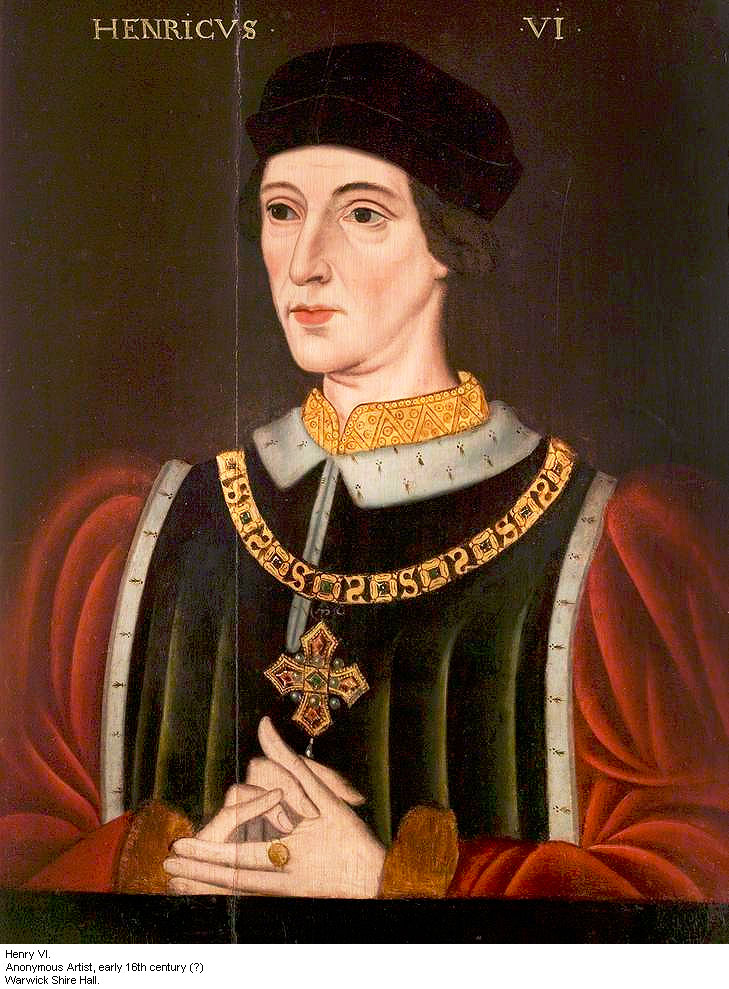
The reign of Henry VI on the English throne was a turbulent and fractious one.


BABY KING
The son of King Henry V and French Princess, Catherine of Valois, was born at Windsor on 6 December 1421. The warrior king, Henry V, was campaigning in France when he suddenly died of dysentery on 31 August 1422. Henry VI became the youngest  ever English monarch the next day and the 10-month-old Henry was proclaimed king of France when his grandfather, Charles VI, died a few weeks later. 

The English nobles swore their allegiance to Henry VI and a regency council gathered to rule in the king's name. Henry VI' mother was kept out of the regency by the king's uncles, John, Duke of Bedford and Humphrey, Duke of Gloucester. Bedford was appointed senior regent of the realm and regent of France whilst Gloucester was appointed Protector and Defender of the Realm.

Bedford knighted the king at Leicester in May 1426 and Henry VI was crowned King of England at Westminster Abbey on 6 November 1429. This was in reaction to Charles VII's defiant coronation as King of France at Reims Cathedral four months earlier.

Henry VI himself was crowned King of France on 26 December 1431 but his power eroded when English allies in Burgundy changed their allegiances and sided with Charles VII during the Congress of Arras in 1435. Bedford died a week before the congress concluded.

A shy and pious Henry VI came of age in 1437 and his peaceful policy towards France caused divisions at court. The king's half-uncle, Cardinal Beaufort, and William de la Pole, Earl of Suffolk, sought peace whilst Gloucester, and Richard, Duke of York, looked for war.

Beaufort and Suffolk convinced Henry VI that a royal marriage to Charles VII's niece, Margaret of Anjou, would bring peace with France. The French king seized on this opportunity and negotiated with Suffolk the return of English territories back to the French in exchange for the marriage. These negotiations were kept secret from the English court for around a year after Henry VI married Margaret of Anjou on 23 April 1445.
Henry VI marriage to Margaret of Anjou
Public anger towards these negotiations focused on Suffolk and the royal couple charged Gloucester with treason in 1447 for instigating this anger. Gloucester soon died in custody and Cardinal Beaufort would die shortly after. Henry VI promoted the Cardinal's nephew, Edmund Beaufort, to 2nd Duke of Somerset and gave him the lieutenancy of France. This caused friction with York who had been demoted from Lieutenant of France to be Lieutenant of Ireland.

Somerset's command of France was disastrous and England's south coast was fearful of a French invasion. Discontent boiled over when Suffolk was caught and executed after Henry VI had allowed him to flee into exile. 


REBELLION
The south-east rebelled under Jack Cade who declared he would "destroy" the king and "bring" York to the throne. Henry VI initially sent a small force to quash the rebellion but fled to Warwickshire once Cade marched on London. Cade was unsuccessful in replacing the king but York returned from Ireland in 1450 to take his place on the council.

York demanded Somerset's arrest over France, which Henry VI initially agreed but the queen's intervention would made Somerset Captain of Calais. An agitated York asserted his claim to the throne in 1452 by marching his troops to London.The city was barred to York and the duke had to concede to the king after being outnumbered in Dartford, Kent. The king placed York under house arrest for two weeks until the duke pledged allegiance and Henry VI would later strip York of his terms of office.
Henry VI sits as Duke of Somerset (centre) and Duke of York argue
Somerset's French campaign began to haunt Henry VI, with the heavy loss at the Battle of Castillon in 1453, reducing England's French domain to just Calais. The king now descended into a mental breakdown with acute schizophrenia and hallucinations preventing him to recognise the birth of his son, Prince Edward, on 13 October 1453.York was declared Protector of the Realm in 1454 and placed Somerset in the Tower of London, but he would soon be released after Henry VI regained his senses later that year.

York took up arms and intercepted the king's forces on 22 May 1455 as Henry VI made his way to Leicester for a Great Council meeting. York had gained the support of the wealthy Neville family and he relied on the father and son of Earl of Salisbury and Earl of Warwick to outnumber the royal forces at the First Battle of St. AlbansThe quick battle through the streets of St. Albans saw the death of Somerset and Henry was deserted by his standard bearer. The king took refuge in a tradesman's house before being discovered by York and escorted back to London.


PRISONER
York declared himself Constable of England and later Protector of the Realm once again when  Henry VI had another bout of mental illness during his imprisonment. The king recovered in February 1456 and had to accept York's influence at court. The queen was less accommodating to York and convinced Henry VI to move court to her heartland of Coventry.

Henry VI tried to nullify the discord between his northern lords and their supporters by having peace talks in 1458 but the queen continued her grievances. York, Salisbury and Warwick were summoned to the Great Council at Coventry and responded by gathering troops at the Battle of Ludford Bridge on 12 October 1459. 

The king promised the Yorkists that he would grant pardons to those who put down their arms and this was too much of an offer for Warwick's Calais troops, led by Andrew Trollope. York and his commanders fled Ludford into exile shortly after hearing of Trollope's treachery. The royal couple issued an act of attainder later that year which forfeited the Yorkist commanders' lands and titles. 

Warwick, Suffolk and York's eldest son, Edward, Earl of March, returned to England in June 1460 and met the royal forces at the Battle of Northampton on 10 July 1460. Treachery struck again, this time in favour of the Yorkists, as Lord Grey of Ruthin, gave March a helping hand over the Lancastrian front line defences. 

Henry VI's commanders defended their king to the death and a victorious Warwick greeted the king outside his royal tent. Warwick and his men swore their allegiances to the king and escorted him to London once more.
Warwick kneels before Henry VI before taking him to London as depicted by Graham Turner
Henry VI's place on the throne was now in doubt as York arrived in London three months later to take the throne but Henry VI's supporters denied York to sit on the throne. After weeks of negotiation, an act of accord was passed that disinherited Prince Edward and recognised York (and his subsequent heirs) as Henry's successors. York was once again made Protector of the Realm and Henry VI was his prisoner.

Meanwhile, the queen was building Lancastrian support and met with the new Scottish king, James III to offer the English border town of Berwick-upon-Tweed in exchange for his support.

York left London to meet the growing Lancastrian forces at the Battle of Wakefield and left Warwick to watch over the royal captor.