Showing posts with label Reinternment. Show all posts

Wednesday, April 1, 2015

A Fitting Tribute

Photo:Adam Hodges
April showers didn't deter visitors from queuing outside Leicester Cathedral today in order to pay their respects to Richard III's tomb. 

I joined the queue inside the nave but it soon stretched outside the door and around the front of the Cathedral in a crowd containing children out of school on their Easter holidays.
Cathedral visitors are welcomed with a quote from Poet Laureate Carol Ann Duffy
Visitors entering the cathedral were quickly reminded of last week's reinternment service with a quote from Poet Laureate Carol Ann Duffy's 'Richard' poem. It was at the reinternment service where Oscar nominee, and distant relative to Richard III, Benedict Cumberbatch, evocatively delivered Richard to the congregation.


Rays of sunlight shone through the Cathedral's stained glass windows on to today's congregation who gathered in the ambulatory to see the tomb. I was allowed to place my hand upon the Swaledale fossil-stone tomb but an usher prevented a couple from taking a 'selfie' beside Richard III's final resting place. The modest North Yorkshire stone is cut with a Christian cross and rests upon a dark Kilkenny-marble plinth etched with Richard III's name, life dates, White Boar emblem, royal coat of arms and motto. 
The deep-cut cross on Richard III's tomb (Photo: Adam Hodges)
The last time I had visited the Cathedral was to see Richard III's coffin a day before the reinterment service  and it was then adorned with a funeral pall, crown and Holy Bible. The funeral pall and crown are now on display in the Cathedral for visitors to examine the embroidery of artist Jacquie Binns depicting events in Richard III's lifetime and his discovery.
Richard III's funeral pall on display (Photo: Adam Hodges)
The crown was commissioned by historian John Ashdown-Hill and placed on the coffin by nine-year old brownie, Emma Chamberlain, during the Service of Repose on March 26 2015. A day which saw thousands, including myself, line the streets of Leicester to see Richard III return to the city.

Spotlights underneath the glass display-case in Leicester Cathedral made the rubies, emeralds, sapphires and plated-gold sparkle on the coronet which resembled the one Richard III adorned on Bosworth Battlefield almost 530 years ago.
The queue to view the tomb stretches outside the cathedral (Photo: Adam Hodges)
Richard III's reburial in late-March brought the world's spotlight on Leicester. The crowd outside the Cathedral and items in the Cathedral giftshop, such as a teddy of a Greyfriar who originally buried Richard III, indicate that many more from around the world will visit the king and his final resting place.

Tuesday, March 31, 2015

Profile - Edmund Plantagenet, Earl of Rutland 1443-1460


Edmund Plantagenent, Earl of Rutland, was second son to Richard, Duke of York, who fought alongside his father at the Battle of Wakefield.

BOY CHANCELLOR
Rutland was born in Rouen, France, in 17 May 1443 as the fifth child and second surviving son of the Duke of York and Cecily Neville. Edmund was granted the Earldom in 1446 and was tutored by Richard Croft at Ludlow Castle, his father's Shropshire estate. York showed his love to his eldest sons, Edward, Earl of March, and Rutland, by giving them green gowns as Easter gifts in 1454 despite York being busy at court becoming Protector of the Realm that spring.

York held the title Lieutenant of Ireland and appointed Rutland as Lord Chancellor of Ireland when his son was just eight-year-old. With Rutland underage, governing Ireland's coffers was tasked to Deputy Chancellors Edmund Oldhall, brother to York's Chamberlain, and then John Talbot, Earl of Shrewsbury. 

Following defeat at the Battle of Ludford Bridge on 12 October 1459, York took Rutland to Ireland via Devon and Wales, whilst leaving his wife and young children, Margaret, George and Richard, to the might of the royal army. The 16-year-old Rutland was able to study his father command order and respect in Ireland but soon discovered their stay in exile wouldn't last long after York discussed return plans with his nephew, Richard Neville, Earl of Warwick, at Waterford in spring 1460.

York and Rutland returned from Ireland on 8 September 1460, landing in north Wales, and traveled to Ludlow and Hereford. It was at Hereford where Rutland met up with his mother and younger siblings but he followed his father's march south to London. York's march was signaled with the flying of the royal standard as if it was his own and York proclaimed his right to the throne by placing a hand upon it on 10 October 1460.

York's actions were derisive and alienated his supporters including Warwick and his father, Richard Neville, Earl of Salisbury. An incensed Warwick challenged York in the pretender's Westminster apartments but a brave and loyal Rutland came to his father's defence by saying to Warwick, "Fair Sir, be not angry, for you know that we have the true right to the crown, and that my lord and father must have it."   
Rutland clashed with the Earl of Warwick following York's public claim to the throne
Rutland's older brother Edward, who had escaped Ludford Bridge to Calais with Warwick, looked to calm the atmosphere by saying to Rutland, "Brother, vex no man, for all shall be well." Edward left the apartments with Warwick and Rutland stayed by his father's side. Later that month, Parliament passed an Act of Accord that decreed York and his heirs would inherit the throne after Henry VI, despite the fact that the king had a son, Prince Edward of Westminster.

Rutland accompanied his father's march north from London on 9 December 1460 after York and Salisbury's northern estates had been looted by Lancastrian forces. After a skirmish with the troops of Henry Beaufort, 3rd Duke of Somerset, at Worksop, Nottinghamshire, York's army reached Sandal Castle near Wakefield on 21 December 1460.

BATTLE
The Battle of Wakefield on 30 December 1460 saw York lead his men out of Sandal Castle in search for a foraging party who had earlier left under the  apparent safety of a Christmas truce. The Lancastrian forces were led by Somerset, Henry Percy, Earl of Northumberland, and Lord John Clifford, whose fathers had all died at First Battle of St. Albans five years previously.

York was ambushed on Wakefield Green and commanded his son to flee the battle to meet up with his brother, Edward, who was building up reinforcements in the Welsh marches. Under protest, Rutland left the battlefield and made it as far as Wakefield Bridge before he was captured. Clifford met his captive on the bridge and was urged by Rutland's tutor, priest Robert Aspell to ransom Rutland, "for he is the Prince's son, and peradventure may do you good hereafter." Clifford replied in anger, "By God’s blood, thy father slew mine and so will I do thee and thy kin,” before stabbing Rutland to death.
Rutland begs Sir John Clifford for mercy
The decapitated head of Rutland would soon join the heads of his father and uncle on spikes atop of Micklegate Bar in York. The bodies of Rutland and York were hastily buried in Pontefract Priory until Edward, now King Edward IV, reinterred them in the family vault at Fotheringhay Castle on 30 January 1466.

Thursday, March 26, 2015

Remembering Richard

I pay my respects to Richard III by his bronze statue

A chill was in the air over the streets of Leicester Wednesday morning as crowds gathered for their last chance to pay their respects to a king in repose before Richard III is reinterred on Thursday.

Leicester Cathedral's doors opened two hours earlier than originally scheduled to accommodate the courteous public who gathered at 4AM on the last day of the coffin's display. Since Monday, 20,000 people have seen the oak coffin and I joined them at 7.15AM in six degree (43F) weather. Early-morning Leicester was under a shroud of grey cloud, a contrast to the glorious sunny Sunday which the procession of Richard III basked in.
The crowd gather at Leicester Cathedral (photo: Adam Hodges)
The line that snaked through the Leicester Cathedral gardens was steadily moving as volunteers supplied cups of tea to the pilgrims who carried white roses. The symbolic York White Rose has brought profit to local florists who have been snipping stems with as much voracity as the blades that clashed on Bosworth Battlefield.

Single white roses were dotted throughout Cathedral Gardens and they congregated around the Richard III statue which was moved from Leicester Castle Gardens in 2014. A security guard watched closely over the bronze statue to ensure that Lancastrian supporters didn't create mischief with red roses placed below the likeliness of the last Yorkist King. Almost 530 years since the Wars of the Roses officially ended and the fight rages on.
Richard lies in repose (photo: Adam Hodges)
The glow of six solemn candles guarded the coffin adorned with a commissioned funeral pall, crown and medieval bible. The line of observers, armed with cameras, smartphones and tablets, were ushered around the font and took a moment to savour the dignified return of the king found underneath a council car park.   
I tie a ribbon of pray outside Leicester Cathedral
The pilgrims were asked to tie a ribbon around the railings of the Cathedral Gardens and I obliged by tying a regal purple ribbon around the black iron railing. 

Across Peacock Lane from the Cathedral is the Richard III Visitor Centre that celebrates Richard III's 'dynasty, death and discovery'. The £4.5 million Visitor Centre combines visual, audio and ethereal qualities that will leave even the harshest critics of Richard III feeling a pang of sympathy towards him. 
Entrance to Richard III Visitor Centre (photo: Adam Hodges)
The tour begins with a video projected behind a throne that depicts Richard's family discussing the early life of the Duke of Gloucester. If you haven't got your ticket in time for the video's beginning, you can enjoy the works of Graham Turner in a temporary exhibit and I took home a small print of one of Turner's majestic works available at the gift shop.
Richard, his Queen and Prince (photo: Adam Hodges)
The tour continues with exhibits that detail Richard III's ascendancy to the throne, the power he wielded once upon it and his unsuccessful defence of the crown. An interactive display allows you to play a 1483-style Cluedo to solve, for yourself, the mystery of the Princes in the Tower that Richard III was, until recently, the prime suspect. A stained glass depiction of King Richard, his Queen and Prince looking over the scales of law makes you contemplate what might have been if Richard had defeated Henry Tudor in 1485.
Bosworth Battlefield Mural (photo by Adam Hodges) 
The Battle of Bosworth is depicted in a fascinating mural with silhouettes of Richard adorning his coronet before the opposing forces collide. The distant past is brought into modern focus upstairs as displays show a roll call of actors who have brought to life Shakespeare's twisted and biased view of Richard III on stage, cinema and television.

But there are always more than one side to a story, no matter how gripping the Bard's tale of greed maybe, and the members of the Richard III Society have been looking for the real Richard III since the 1920s. Phillipa Langley, Scottish President of the Richard III Society, was inspired to discover Richard from David Baldwin's and John Ashdown-Hill's hypotheses of Richard's burial on the former site of Greyfriars church.

The search and subsequent discovery of Richard III's skeleton are exhibited with videos, documents and intimate relics from 2012. These include the digger bucket and mattock that broke ground above the grave, Langley's Union Jack Wellington boots worn on the day of discovery and Ashdown-Hill's flag of Richard's royal standard that adorned the box of bones carried away from the excavation.
Archaeologists Matthew Morris and Richard Buckley (photo: Adam Hodges)
The archaeologists behind the dig, Matthew Morris and Richard Buckley, were at the Richard III Visitor Centre Wednesday to sign copies of the book, 'Richard III the King Under the Car Park' and I congratulated them on the work done at the Visitor Centre. 

The penultimate exhibit of the tour details the marvels of modern science with Richard's death wounds, DNA identification and reconstructed face displayed.
Richard III's discovery is brought to life (photo: Adam Hodges)
The tale of a king found underneath a car park is a fascinating one and it is recreated breathtakingly at the conclusion of the tour. A glass floor allows you to walk over the excavated trench. A chill went down my spine when I saw the hologram of the skeleton, slumped in a hastily dug grave, fade in and out of view, accompanied by a solemn choir reminiscent of the Grey Friars who gave Richard his first burial.

Haste has given way to thoughtful planning for Richard III's reburial taking place on Thursday. Richard may have been buried for over 500 years but his life and legacy hasn't been forgotten. And neither will I forget the day I visited his grave site and revered coffin.

Monday, March 23, 2015

Richard III's Dignified Return to Leicester

Richard III passes by me as I take a photo on the front row (last on the right, bottom right corner)

An early spring sun set over the City of Leicester and the thousands of people who lined the streets to watch the reinterment procession of the last Plantagenet king.

The sun glinted down High Street and on to the polished battle armour of the two medieval knights on horseback who led the procession. They guarded a horse-drawn carriage that carried an understated Engish oak coffin crafted by Canadian cabinet maker, Michael Ibsen. Inside the coffin were the remains of Ibsen's 17th great grand-uncle and 15th Century monarch, Richard III.  

Richard III's journey through Leicester and it's surrounding villages began six hours earlier at the University of Leicester. A ceremony led by University of Leicester Chancellor Lord Grocott saw attendees symbolically place individual white roses on to the coffin of the the last king to die in battle during the Wars of the Roses.
Michael Ibsen places a white rose on Richard III's coffin (Leicester Mercury)
The king left Leicester on 21 August 1485 to meet Henry Tudor at the Battle of Bosworth and a hearse carrying the coffin travelled to the battleground at Fenn Lane Farm for a private service. Phillipa Langley, major contributor to the king's 2012 discovery, carried a casket containing the soils from the land where Richard III was born (Fotheringhay), lived (Middleham) and died (Fenn Lane). The soils will later be scattered into the tomb in Leicester Cathedral when the king is reburied on Thursday 26 March.
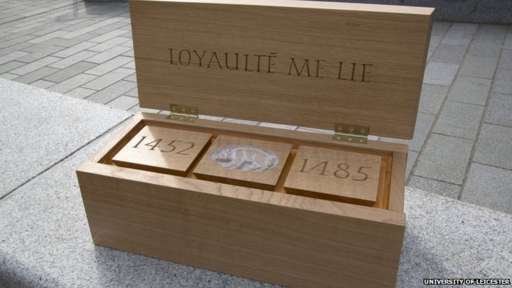
Richard III's casket containing sacred soil (University of Leicester) 
From Fenn Lane Farm, the cortege went through the villages of Dadlington (resting place of many of the Battle of Bosworth's fallen soldiers), Sutton Cheney (where Richard III took communion before the battle) and Market Bosworth. 

Another ceremony at the Bosworth Battlefield Centre saw the coffin being pulled on a gun carriage by local army cadets. Rt Rev Tim Stevens, Bishop of Leicester, led a service where the Bishop recalled that, "Richard was carried from this field to Leicester as a defeated man... Today, 530 years later, we have an opportunity to allow Richard to take that journey again but this time with the dignity which befits a king." 

A 21 gun salute fired by re-enactors on replica cannons followed as the cortege made its way back to Leicester via the villages of Newbold Verdon and Desford. In August 1485, Richard III's battle ravaged naked body was strewn over the side of a horse and rode back to Leicester to be paraded by a victorious Henry VII. The journey to Leicester via Bow Bridge was more dignified this time as people along the route threw dozens of white roses on to the hearse in respect.
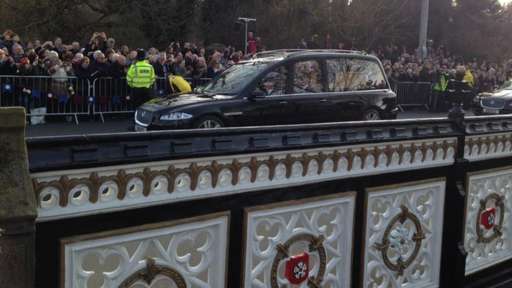
Richard III's hearse crosses Bow Bridge (BBC)
The coffin was transferred to a horse drawn carriage after a short service at St. Nicholas Church and the armoured escort took the cortege down High Street.


The crowd that had gathered around Leicester's Clock Tower let out a cheer as the cortege emerged from the crowded corner of Eastgates. The 19th century Clock Tower includes a statue of Simon de Montford, Earl of Leicester, who rebelled against King Henry III's overbearing rule. De Montfort was killed in battle by Roger Mortimer, Richard III's 7th great grandfather, but it was De Montfort's statue who looked down upon Richard III as a requiem played through the speakers beside the Clock Tower.
Simon de Montfort's statue on the base of the Clock Tower looks on (photo by Adam Hodges)
The medieval cortege made it's way past outlets including McDonalds, Vape Joy and Poundland whilst onlookers took photographs with telephoto lenses and smartphones. Richard III's coffin stopped in front of Leicester Cathedral yards from where he was discovered underneath a council car park in 2012. Richard Buckley, Director of University of Leicester Archaeological Services, formally handed over the king's remains to the Dean of Leicester, the Very Revd David Monteith, as the Cathedral bells tolled.
Richard III's armoured escort passes McDonalds (photo by Adam Hodges)
The knights remained on horseback and guarded the Cathedral entrance as the coffin was taken inside. A Service of Compline took place in the cathedral where Richard III's coffin was adorned with a specially commissioned funeral pall, medieval bible and a replica of the King's crown was laid on the coffin by nine-year-old Emma Chamberlain from the 1st Aylestone Brownies.
Richard III inside Leicester Cathedral (Leicester Mercury)
The sermon given by Cardinal Vincent Nichols, Archbishop of Westminster, during the service described Richard III as a "child of war" and "refugee in Europe" who became King and "reshaped vital aspects of the legal system." 

Richard III will remain in repose until Thursday when a Service of Reinternment at Leicester Cathedral led by the Archbishop of Cantebury will see a reburial fit for a king.