Showing posts with label Yorkist. Show all posts

Tuesday, March 31, 2015

Profile - Edmund Plantagenet, Earl of Rutland 1443-1460


Edmund Plantagenent, Earl of Rutland, was second son to Richard, Duke of York, who fought alongside his father at the Battle of Wakefield.

BOY CHANCELLOR
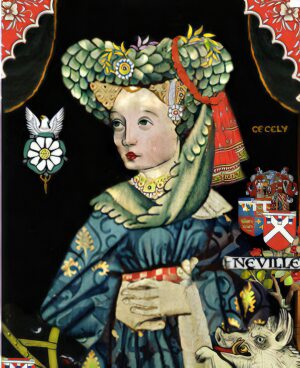
Rutland was born in Rouen, France, in 17 May 1443 as the fifth child and second surviving son of the Duke of York and Cecily Neville. Edmund was granted the Earldom in 1446 and was tutored by Richard Croft at Ludlow Castle, his father's Shropshire estate. York showed his love to his eldest sons, Edward, Earl of March, and Rutland, by giving them green gowns as Easter gifts in 1454 despite York being busy at court becoming Protector of the Realm that spring.

York held the title Lieutenant of Ireland and appointed Rutland as Lord Chancellor of Ireland when his son was just eight-year-old. With Rutland underage, governing Ireland's coffers was tasked to Deputy Chancellors Edmund Oldhall, brother to York's Chamberlain, and then John Talbot, Earl of Shrewsbury. 

Following defeat at the Battle of Ludford Bridge on 12 October 1459, York took Rutland to Ireland via Devon and Wales, whilst leaving his wife and young children, Margaret, George and Richard, to the might of the royal army. The 16-year-old Rutland was able to study his father command order and respect in Ireland but soon discovered their stay in exile wouldn't last long after York discussed return plans with his nephew, Richard Neville, Earl of Warwick, at Waterford in spring 1460.

York and Rutland returned from Ireland on 8 September 1460, landing in north Wales, and traveled to Ludlow and Hereford. It was at Hereford where Rutland met up with his mother and younger siblings but he followed his father's march south to London. York's march was signaled with the flying of the royal standard as if it was his own and York proclaimed his right to the throne by placing a hand upon it on 10 October 1460.

York's actions were derisive and alienated his supporters including Warwick and his father, Richard Neville, Earl of Salisbury. An incensed Warwick challenged York in the pretender's Westminster apartments but a brave and loyal Rutland came to his father's defence by saying to Warwick, "Fair Sir, be not angry, for you know that we have the true right to the crown, and that my lord and father must have it."   
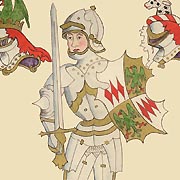
Rutland clashed with the Earl of Warwick following York's public claim to the throne
Rutland's older brother Edward, who had escaped Ludford Bridge to Calais with Warwick, looked to calm the atmosphere by saying to Rutland, "Brother, vex no man, for all shall be well." Edward left the apartments with Warwick and Rutland stayed by his father's side. Later that month, Parliament passed an Act of Accord that decreed York and his heirs would inherit the throne after Henry VI, despite the fact that the king had a son, Prince Edward of Westminster.

Rutland accompanied his father's march north from London on 9 December 1460 after York and Salisbury's northern estates had been looted by Lancastrian forces. After a skirmish with the troops of Henry Beaufort, 3rd Duke of Somerset, at Worksop, Nottinghamshire, York's army reached Sandal Castle near Wakefield on 21 December 1460.

BATTLE
The Battle of Wakefield on 30 December 1460 saw York lead his men out of Sandal Castle in search for a foraging party who had earlier left under the  apparent safety of a Christmas truce. The Lancastrian forces were led by Somerset, Henry Percy, Earl of Northumberland, and Lord John Clifford, whose fathers had all died at First Battle of St. Albans five years previously.

York was ambushed on Wakefield Green and commanded his son to flee the battle to meet up with his brother, Edward, who was building up reinforcements in the Welsh marches. Under protest, Rutland left the battlefield and made it as far as Wakefield Bridge before he was captured. Clifford met his captive on the bridge and was urged by Rutland's tutor, priest Robert Aspell to ransom Rutland, "for he is the Prince's son, and peradventure may do you good hereafter." Clifford replied in anger, "By God’s blood, thy father slew mine and so will I do thee and thy kin,” before stabbing Rutland to death.
Rutland begs Sir John Clifford for mercy
The decapitated head of Rutland would soon join the heads of his father and uncle on spikes atop of Micklegate Bar in York. The bodies of Rutland and York were hastily buried in Pontefract Priory until Edward, now King Edward IV, reinterred them in the family vault at Fotheringhay Castle on 30 January 1466.

Friday, March 27, 2015

Profile - Richard Neville, Earl of Salisbury 1400-1460

Richard Neville, 5th Earl of Salisbury, was a key Yorkist supporter in the beginning of the Wars of the Roses, and was also brother-in-law to Richard, Duke of York.

WARDEN OF THE NORTH
The Earl of Salisbury was born in 1400 at Raby Castle in County Durham and was the eldest son of Ralph de Neville, 1st Earl of Westmorland, and Joan Beaufort, daughter of John of Gaunt and Katherine Swynford. Salisbury's father was responsible for the wardship of the orphaned Duke of York, and Ralph Neville betrothed the wealthy duke to his youngest daughter, Cecily.

Richard Neville was married to Alice Montacute, daughter and heiress of Thomas Montacute, the Earl of Salisbury, sometime before February 1421 when they attended the coronation of Queen Catherine of Valois as a married couple. Ralph Neville died in 1425 and Richard inherited the family residence of Middleham Castle with the Earldom of Salisbury coming three years later when Alice's father died.
Middleham Castle - Seat of Neville Power
Salisbury became a commander at the age of 20 when appointed Warden of the West March on the Scottish border and was rewarded by Henry V in his appointment of Justice of the Peace in Cumberland, Westmoreland, and Durham. Salisbury began to frequent the royal court and accompanied the young King Henry VI to France for his coronation in 1431 and his fealty was rewarded by becoming Warden of the East March on the Welsh border.

In 1436, Salisbury resigned from both posts and accompanied York, the newly appointed Lieutenant of France, with 1,300 men-at-arms and archers to protect English lands on the French domain. Salisbury returned the following year and was repaid with a seat on the King's Council whilst also resuming the Wardenship of the West March. The wardenship caused resentment with the Percy family, who had lands just south of the Scottish border in Northumberland.

The Percys were aggrieved when Salisbury recruited men in their Cumberland and Westmorland estates and the Percys flouted Salisbury's rule during the Battle of Sark against the Scots in 1448. Salisbury was to feel the wrath of the Percys up close on 24 August 1453 when Thomas Percy, Lord Egremont, attacked Salisbury at Heworth Moor, outside York, on the journey home to Sheriff Hutton. Salisbury was returning from the wedding of his son Thomas and he fought off Egremont's men unscathed.

YORKIST
Salisbury's eldest son became Richard Neville, 16th Earl of Warwick when he married the Warwick heiress Anne Beauchamp in 1449. Warwick was to exceed his father in lands, wealth and titles but remained loyal and Salisbury would take a high place in the Privy Council after Henry VI's mental breakdown. 

During the king's illness, York was elected Protector of the Realm on 27 March 1454 and assigned his brother-in-law as Chancellor. Salisbury wasn't able to tackle government overspending for long as York's influence diminished when Henry VI regained his sense on Christmas Day 1454. York and Warwick's enemy, Edmund Beaufort, 2nd Duke of Somerset, was released from the Tower of London and Salisbury resigned as Chancellor in 1455.
Henry VI's return to health saw Salisbury resign as Chancellor
English queen, Margaret of Anjou, focused her resentment on the Yorkists and requested the nobles to attend a Great Council meeting in Leicester on 21 May 1455. York, along with Salisbury and Warwick, saw the invitation as a ruse and took up arms to intercept the royal party before they reached Leicester.

Yorkist and royal forces clashed at the First Battle of St. Albans where Salisbury's and York's attempts to break the Lancastrian front line was assisted by Warwick's surprise attack from Lord Thomas Clifford's rear. The Lancastrian army was defeated and the king's lieutenants, including Henry Percy, 2nd Earl of Northumberland, were killed. Henry VI was discovered in a tanner's house and Salisbury bent the knee with York and Warwick to show their allegiance to the king. 

Salisbury rode alongside the king as he was escorted back to London and his son was appointed Captain of Calais after York was proclaimed Constable of England that was later relinquished when Henry VI returned to good health. Warwick kept his captaincy of Calais and Margaret convinced the king to move the royal court to Coventry in Lancastrian heartland. York and Salisbury retired to their estates of Ludlow and Middleham but Salisbury was soon aggravated by the Percys.

Henry VI looked for peace throughout the nobility and called for talks in early 1458. The talks were disrupted by Sir John Clifford, Henry Percy, 3rd Earl of Northumberland and Henry Beaufort, 3rd Duke of Somerset, whose fathers died at St. Albans. Henry VI conceded and allowed them to be compensated by York, Salisbury and Warwick. The peace talks culminated at Loveday 24 March 1458 but the public display of peace didn't continue as Margaret of Anjou and Warwick sparred with each other either side of the English Channel with Warwick lucky to escape London with his life.

MASTER OF DECEPTION
York and Salisbury gathered troops in anticipation and word was sent to Warwick to do the same. Salisbury left Middleham and marched south-west to meet York but was intercepted by royal forces at the Battle of Blore Heath on 23 September 1459. 
Lord Audley leads the attack on Salisbury
Margaret of Anjou had heard of Salisbury's movements and sent James Tuchet, Lord Audley, to intercept him. Audley chose the open field of Blore Heath in Staffordshire to attack Salisbury with his 10,000 men and took position behind a stream out Salisbury's archers range. Salisbury showed his experience by enticing Audley to cavalry charge when he feinted a retreat and two subsequent charges from the Lancastrians couldn't break Salisbury's lines. The fighting left 2,000 Lancastrians, including Audley, dead.

Salisbury was aware that the main Lancastrian army was nearby and tasked a friar to fire cannons left on the battlefield to mask his retreat. This ingenuity resulted in Salisbury linking up with York and Warwick by Ludlow. The royal army forced York to encamp south of Ludlow at the Battle of Ludford Bridge. The king's presence led to the defection of Warwick's forces and the three Yorkist commanders fled the battlefield with Salisbury, Warwick and York's son, Edward, Earl of March, headed south to Calais.

Exile in Calais lasted eight months with Warwick meeting with York in Ireland in March 1460 to plan their return two months later. Salisbury stayed in London to hold the city as Warwick and March successfully fought the royal forces at Battle of Northampton. Warwick returned to London with the king and York came to the city on 10 October 1460 to claim the throne for himself. York's unsuccessful public display to take the throne for himself alienated Salisbury and Warwick who were hesitant in deposing the king.

An Act of Accord on 24 October 1460 decreed that York and his subsequent heirs would inherit the throne after Henry VI but Margaret of Anjou was courting Scottish support with James III. 

News of Northumberland mobilising forces and raiding Salisbury and York estates led the two nobles, along with York's second eldest son, Edmund, Earl of Rutland, to leave London and march north. The Yorkist army clashed with Edmund Beaufort's army at Worksop, Nottinghamshire, and reached Sandal Castle near Wakefield on 21 December 1460. York was drawn out onto Wakefield Green and ambushed at the Battle of Wakefield on 30 December 1460. 

A crushing Yorkist defeat saw York die on the battlefield and Rutland was caught fleeing the battle and executed. Salisbury's attempt to flee the lost battle lasted a few more hours than Rutland's and he was caught and held at Pontefract Castle. Salisbury's captors were contemplating a ransom when the earl bribed a jailor to apparent safety but commoners saw Salisbury leaving, sprung an attack and executed him.

Salisbury's head would be spiked alongside those of York and Rutland on Mickelgate Bar in York but the Neville dynasty didn't end there. Warwick would later be the "Kingmaker" and Salisbury's grand-daughter, Anne Neville, became Queen Consort when Richard III came to the throne 23 years after the rout at Wakefield.

Wednesday, March 18, 2015

Profile: Richard Duke of York. Part 1 1411-1447


Richard Plantagenet, 3rd Duke of York, was arguably one of the most influential figures in 15th century England. 
BIRTHRIGHT 
Royal blood richly coursed through Richard's veins as he was great grandson to King Edward III on his father's side and great, great grandson to the same monarch on his mother's side. Richard's claim to the throne was based on him being the maternal descendant of Edward III's third son, Lionel of Antwerp, 1st Duke of Clarence.
Edward III outlived his first three sons and his fourth, John of Gaunt, 1st Duke of Lancaster, exercised great influence over the minority of King Richard II. Upon John of Gaunt's death in 1399, the king disinherited Lancaster's son, Henry Bolingbroke, from his father's titles. Bolingbroke took up arms, declared himself king and imprisoned Richard II.
Henry IV staked his claim over heir presumptive, eight-year-old Edmund Mortimer, through his direct male line to the throne, instead of Mortimer's descent via his grandmother.

Edmund's sister, Anne Mortimer, married Richard of Conisburgh in 1406 and on 21 September, 1411, they had a son - Richard Plantagenet. Anne, however, didn't live past child-birth.
Richard Conisburgh, father to Richard Plantagenet
Richard would become an orphan four years later when his father was beheaded for treason. Henry IV died in 1413 and his son, Henry V, took the throne. Conisburgh was made Earl of Cambridge in 1414 but had no lands to accompany the earldom. Cambridge lacked resources to equip himself for King Henry V's French expedition and conspired with Henry Scrope and Sir Thomas Grey to place Edmund Mortimer on the throne. Mortimer revealed his brother-in-law's plot to the king and was part of the commission which passed the death sentence on the Southampton Plot conspirators.

Cambridge pleaded the king for mercy but was beheaded on 5 August 1415 and buried in Southampton's God's House chapel. Henry V's fleet set sail six days later for a successful campaign that culminated at the Battle of Agincourt. Cambridge's eldest brother, Edward, 2nd Duke of York, died at Agincourt and his land and titles passed to Richard Plantagenet. 

Richard's uncle, Edmund Mortimer, died in 1425 and the Duke of York inherited his lands. York's vast wealth was now only second to the king.

York was made a ward of the crown in 1417 and the wardship was awarded to Ralph Neville, Earl of Westmorland. York was placed under the guardianship of Robert Waterton at Pontefract Castle. Neville saw the potential in York and betrothed him at 13 years-of-age to his nine-year-old daughter, Cecily Neville.


Cecily Neville - Richard, Duke of York's wife
York was knighted by Henry V's brother, John of Lancaster, Duke of Bedford, in Leicester on 19 May 1426. His marriage to Cecily Neville took place in October 1429 and York was able to take control of his estates and inheritance three years later.

Henry V had died suddenly in 1422 and the crown passed to his nine-month old son, Henry VI. The regency council governed England and they were preempted to crown the king on 6 November 1429 after the French had crowned Charles VII four months earlier. The regency council looked to reaffirm England's right to France and Henry VI's French coronation was on 26 December 1431. York was present at both of Henry VI's coronations as he took his place on the king's council.


COMMANDER
Following Bedford's death in 1436, York succeeded him as Lieutenant of France and had to contend with the alliance between France and Burgundy that no longer recognised Henry VI's claim to the French throne. Bedford's former captains assisted York in recapturing Fecamp, maintaining Pays de Caux and keeping order and justice in Normandy.

York was dissatisfied with the terms of his appointment as he had to finance his troops' wages and other expenses. He returned to England in November 1439 to find that he was no longer included in Henry VI's Council. The council looked for peace with France but reappointed York as Lieutenant of France after negotiations had broken down and York was now granted powers similar to what Bedford had before.

Henry VI granted John Beaufort, Duke of Somerset (and self declared Captain-General of Gascony), an army of 7,000 men that was dispatched to the French port of Cherbourg in August 1443. Somerset marched his army south to Gascony and his command denied York of much needed troops and resources at a time when York  was struggling to hold the borders of Normandy in northern France. Somerset's needless campaign antagonised prior peace treaties and he retreated north to Normandy where he would die shortly afterwards.

The remaining two years of York's lieutenancy was spent in routine administration and domestic matters with England looking for peace once again with France. Cecily accompanied him in Normandy and she gave birth to sons, Edward and Edmund, and daughter Elizabeth in Rouen between 1442 and 1444.

The king took council with Cardinal Beaufort and WIlliam de la Pole, Earl of Suffolk, who advised that peace with France lay with marrying Margaret of Anjou, niece to the French King, Charles VII. The French king drove a hard bargain and the Treaty of Tours allowed the territories of Maine and Anjou to be handed over to France in exchange for the marriage. The terms were kept secret from the English parliament for a year after Henry VI had married Margaret of Anjou at Tichfield Abbey on 23 April 1445.


Henry VI marriage to Margaret of Anjou
York returned to England on 20 October 1445 and was expecting a third term as Lieutenant of France but the appointment went to Edmund Beaufort, 2nd Duke of Somerset, brother to York's fallen foe, John Beaufort. 

Henry VI and his 17-year-old queen had yet to have a child and York was made heir presumptive when Henry VI's uncle, Humphrey, Duke of Gloucester, died in 1447. However, York, was unofficially exiled when he was made Lieutenant of Ireland as the 10 year term would rule him out of consideration for any other roles in high office.