Showing posts with label Leicester. Show all posts

Thursday, March 26, 2015

Remembering Richard

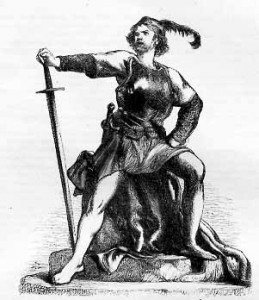
I pay my respects to Richard III by his bronze statue

A chill was in the air over the streets of Leicester Wednesday morning as crowds gathered for their last chance to pay their respects to a king in repose before Richard III is reinterred on Thursday.

Leicester Cathedral's doors opened two hours earlier than originally scheduled to accommodate the courteous public who gathered at 4AM on the last day of the coffin's display. Since Monday, 20,000 people have seen the oak coffin and I joined them at 7.15AM in six degree (43F) weather. Early-morning Leicester was under a shroud of grey cloud, a contrast to the glorious sunny Sunday which the procession of Richard III basked in.
The crowd gather at Leicester Cathedral (photo: Adam Hodges)
The line that snaked through the Leicester Cathedral gardens was steadily moving as volunteers supplied cups of tea to the pilgrims who carried white roses. The symbolic York White Rose has brought profit to local florists who have been snipping stems with as much voracity as the blades that clashed on Bosworth Battlefield.

Single white roses were dotted throughout Cathedral Gardens and they congregated around the Richard III statue which was moved from Leicester Castle Gardens in 2014. A security guard watched closely over the bronze statue to ensure that Lancastrian supporters didn't create mischief with red roses placed below the likeliness of the last Yorkist King. Almost 530 years since the Wars of the Roses officially ended and the fight rages on.
Richard lies in repose (photo: Adam Hodges)
The glow of six solemn candles guarded the coffin adorned with a commissioned funeral pall, crown and medieval bible. The line of observers, armed with cameras, smartphones and tablets, were ushered around the font and took a moment to savour the dignified return of the king found underneath a council car park.   
I tie a ribbon of pray outside Leicester Cathedral
The pilgrims were asked to tie a ribbon around the railings of the Cathedral Gardens and I obliged by tying a regal purple ribbon around the black iron railing. 

Across Peacock Lane from the Cathedral is the Richard III Visitor Centre that celebrates Richard III's 'dynasty, death and discovery'. The £4.5 million Visitor Centre combines visual, audio and ethereal qualities that will leave even the harshest critics of Richard III feeling a pang of sympathy towards him. 
Entrance to Richard III Visitor Centre (photo: Adam Hodges)
The tour begins with a video projected behind a throne that depicts Richard's family discussing the early life of the Duke of Gloucester. If you haven't got your ticket in time for the video's beginning, you can enjoy the works of Graham Turner in a temporary exhibit and I took home a small print of one of Turner's majestic works available at the gift shop.
Richard, his Queen and Prince (photo: Adam Hodges)
The tour continues with exhibits that detail Richard III's ascendancy to the throne, the power he wielded once upon it and his unsuccessful defence of the crown. An interactive display allows you to play a 1483-style Cluedo to solve, for yourself, the mystery of the Princes in the Tower that Richard III was, until recently, the prime suspect. A stained glass depiction of King Richard, his Queen and Prince looking over the scales of law makes you contemplate what might have been if Richard had defeated Henry Tudor in 1485.
Bosworth Battlefield Mural (photo by Adam Hodges) 
The Battle of Bosworth is depicted in a fascinating mural with silhouettes of Richard adorning his coronet before the opposing forces collide. The distant past is brought into modern focus upstairs as displays show a roll call of actors who have brought to life Shakespeare's twisted and biased view of Richard III on stage, cinema and television.

But there are always more than one side to a story, no matter how gripping the Bard's tale of greed maybe, and the members of the Richard III Society have been looking for the real Richard III since the 1920s. Phillipa Langley, Scottish President of the Richard III Society, was inspired to discover Richard from David Baldwin's and John Ashdown-Hill's hypotheses of Richard's burial on the former site of Greyfriars church.

The search and subsequent discovery of Richard III's skeleton are exhibited with videos, documents and intimate relics from 2012. These include the digger bucket and mattock that broke ground above the grave, Langley's Union Jack Wellington boots worn on the day of discovery and Ashdown-Hill's flag of Richard's royal standard that adorned the box of bones carried away from the excavation.
Archaeologists Matthew Morris and Richard Buckley (photo: Adam Hodges)
The archaeologists behind the dig, Matthew Morris and Richard Buckley, were at the Richard III Visitor Centre Wednesday to sign copies of the book, 'Richard III the King Under the Car Park' and I congratulated them on the work done at the Visitor Centre. 

The penultimate exhibit of the tour details the marvels of modern science with Richard's death wounds, DNA identification and reconstructed face displayed.
Richard III's discovery is brought to life (photo: Adam Hodges)
The tale of a king found underneath a car park is a fascinating one and it is recreated breathtakingly at the conclusion of the tour. A glass floor allows you to walk over the excavated trench. A chill went down my spine when I saw the hologram of the skeleton, slumped in a hastily dug grave, fade in and out of view, accompanied by a solemn choir reminiscent of the Grey Friars who gave Richard his first burial.

Haste has given way to thoughtful planning for Richard III's reburial taking place on Thursday. Richard may have been buried for over 500 years but his life and legacy hasn't been forgotten. And neither will I forget the day I visited his grave site and revered coffin.

Monday, March 23, 2015

Richard III's Dignified Return to Leicester

Richard III passes by me as I take a photo on the front row (last on the right, bottom right corner)

An early spring sun set over the City of Leicester and the thousands of people who lined the streets to watch the reinterment procession of the last Plantagenet king.

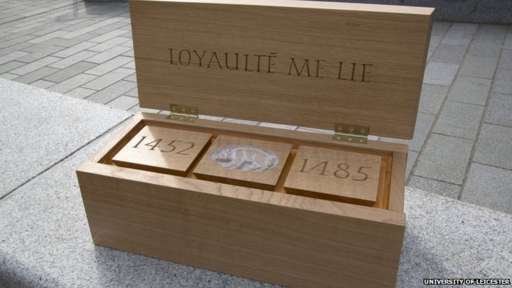
The sun glinted down High Street and on to the polished battle armour of the two medieval knights on horseback who led the procession. They guarded a horse-drawn carriage that carried an understated Engish oak coffin crafted by Canadian cabinet maker, Michael Ibsen. Inside the coffin were the remains of Ibsen's 17th great grand-uncle and 15th Century monarch, Richard III.  

Richard III's journey through Leicester and it's surrounding villages began six hours earlier at the University of Leicester. A ceremony led by University of Leicester Chancellor Lord Grocott saw attendees symbolically place individual white roses on to the coffin of the the last king to die in battle during the Wars of the Roses.
Michael Ibsen places a white rose on Richard III's coffin (Leicester Mercury)
The king left Leicester on 21 August 1485 to meet Henry Tudor at the Battle of Bosworth and a hearse carrying the coffin travelled to the battleground at Fenn Lane Farm for a private service. Phillipa Langley, major contributor to the king's 2012 discovery, carried a casket containing the soils from the land where Richard III was born (Fotheringhay), lived (Middleham) and died (Fenn Lane). The soils will later be scattered into the tomb in Leicester Cathedral when the king is reburied on Thursday 26 March.
Richard III's casket containing sacred soil (University of Leicester) 
From Fenn Lane Farm, the cortege went through the villages of Dadlington (resting place of many of the Battle of Bosworth's fallen soldiers), Sutton Cheney (where Richard III took communion before the battle) and Market Bosworth. 

Another ceremony at the Bosworth Battlefield Centre saw the coffin being pulled on a gun carriage by local army cadets. Rt Rev Tim Stevens, Bishop of Leicester, led a service where the Bishop recalled that, "Richard was carried from this field to Leicester as a defeated man... Today, 530 years later, we have an opportunity to allow Richard to take that journey again but this time with the dignity which befits a king." 

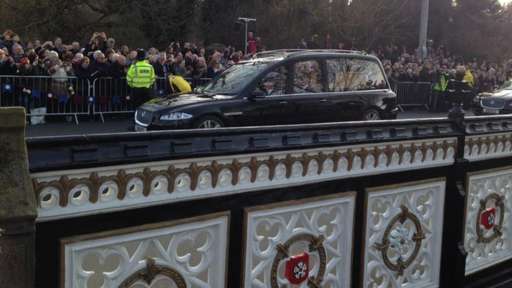
A 21 gun salute fired by re-enactors on replica cannons followed as the cortege made its way back to Leicester via the villages of Newbold Verdon and Desford. In August 1485, Richard III's battle ravaged naked body was strewn over the side of a horse and rode back to Leicester to be paraded by a victorious Henry VII. The journey to Leicester via Bow Bridge was more dignified this time as people along the route threw dozens of white roses on to the hearse in respect.
Richard III's hearse crosses Bow Bridge (BBC)
The coffin was transferred to a horse drawn carriage after a short service at St. Nicholas Church and the armoured escort took the cortege down High Street.


The crowd that had gathered around Leicester's Clock Tower let out a cheer as the cortege emerged from the crowded corner of Eastgates. The 19th century Clock Tower includes a statue of Simon de Montford, Earl of Leicester, who rebelled against King Henry III's overbearing rule. De Montfort was killed in battle by Roger Mortimer, Richard III's 7th great grandfather, but it was De Montfort's statue who looked down upon Richard III as a requiem played through the speakers beside the Clock Tower.
Simon de Montfort's statue on the base of the Clock Tower looks on (photo by Adam Hodges)
The medieval cortege made it's way past outlets including McDonalds, Vape Joy and Poundland whilst onlookers took photographs with telephoto lenses and smartphones. Richard III's coffin stopped in front of Leicester Cathedral yards from where he was discovered underneath a council car park in 2012. Richard Buckley, Director of University of Leicester Archaeological Services, formally handed over the king's remains to the Dean of Leicester, the Very Revd David Monteith, as the Cathedral bells tolled.
Richard III's armoured escort passes McDonalds (photo by Adam Hodges)
The knights remained on horseback and guarded the Cathedral entrance as the coffin was taken inside. A Service of Compline took place in the cathedral where Richard III's coffin was adorned with a specially commissioned funeral pall, medieval bible and a replica of the King's crown was laid on the coffin by nine-year-old Emma Chamberlain from the 1st Aylestone Brownies.
Richard III inside Leicester Cathedral (Leicester Mercury)
The sermon given by Cardinal Vincent Nichols, Archbishop of Westminster, during the service described Richard III as a "child of war" and "refugee in Europe" who became King and "reshaped vital aspects of the legal system." 

Richard III will remain in repose until Thursday when a Service of Reinternment at Leicester Cathedral led by the Archbishop of Cantebury will see a reburial fit for a king.


Thursday, March 19, 2015

First Battle of St. Albans 1455

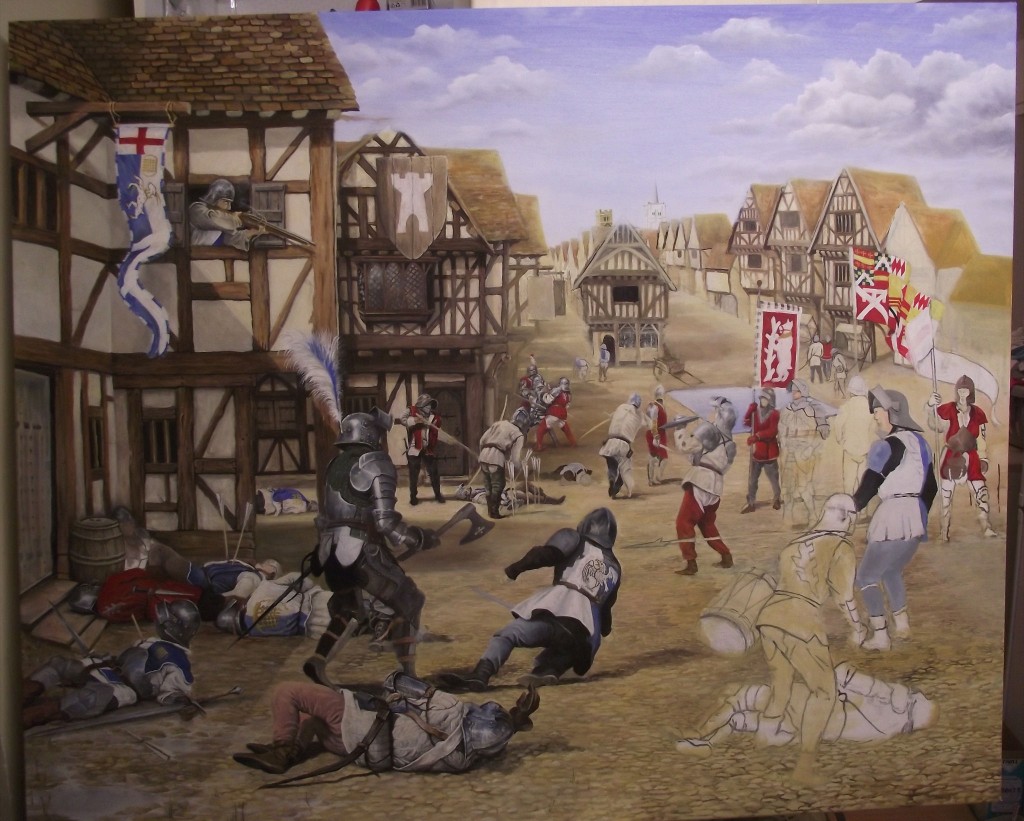
First Battle of St. Albans depicted by Matthew Ryan 
The 'Cousins War' or 'War of the Roses' fought between England's nobility began in earnest at St. Albans on 22 May 1455.

BACKGROUND
Henry VI's mental breakdown after heavy English defeats in France in 1453 brought the need for governance and Richard, Duke of York, became Protector of the Realm on 27 March 1454. 

York had held grievances with Edmund Beaufort, 2nd Duke of Somerset, ever since the king decided to make Somerset Lieutenant of France in 1448 instead of granting a third term to the incumbent York.
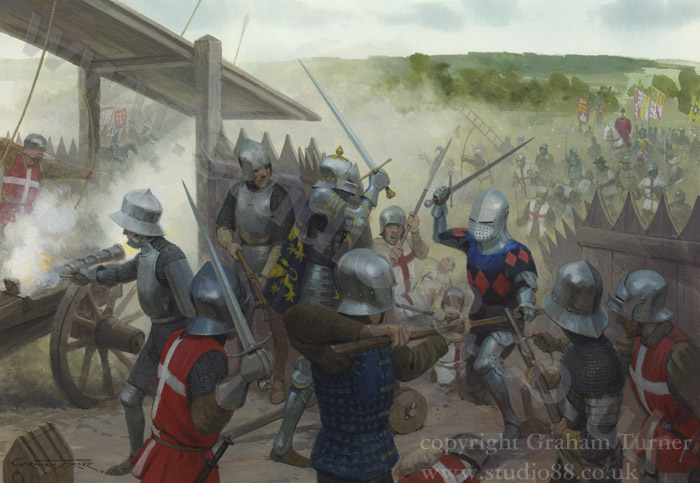
Battle of Castillon of 1453 depicted by Graham Turner
Somerset's term in office was disastrous, with the heavy defeat at the Battle of Castillon in 1453 leaving Calais as the only English territory in mainland France. York had previous animosity to Somerset's father when the king had shown favouritism towards the 1st Duke of Somerset by granting him, and not York, much needed troops in France 10 years earlier.

York charged the 2nd Duke of Somerset for failing to assert England's authority in France and imprisoned him in the Tower of London.  But Somerset was soon to be freed when Henry VI recovered in late 1454. Henry VI continued to antagonise York by removing him as Captain of Calais and replaced him with Somerset.

The king summoned the meeting of the Great Council in Leicester and York viewed this invitation cautiously. York met with his loyal commanders, Neville father and son, Earl of Salisbury and Earl of Warwick, and decided to march south with a growing force to meet the king before he arrived at Leicester.

York sent word to Henry VI and the Archbishop of Cantebury of his intentions to not harm the king due to his faith and allegiance but took up arms to counter the "sinister, malicious and fraudulent" members of government. 

BATTLE
Henry VI's army of 2,000 troops arrived at St. Albans first on 22 May 1455 and encamped along Tonman Ditch. The 7,000-strong Yorkist army arrived and made camp in Keyfield to the east of the barred town. Negotiations lasted three hours but broke down when York's demands of Somerset's surrender were denied. 

York led the surprise attack on the town before noon but was repulsed at the barricades by Lord Thomas Clifford and his men. Warwick outflanked the Lancastrians by rushing through the gardens between Key Inn and Chequer Inn and attacked Clifford's men from behind.

The battle through the streets of St. Albans lasted around half an hour as the Lancastrian rank and file deserted their nobles. Somerset, Clifford and Henry Percy, Earl of Northumberland, lay dead.  

Humphrey Stafford, Duke of Buckingham, sought sanctuary in the town's abbey after being hit in the face by an arrow and the Yorkist archers struck the king in the neck. Henry VI was left alone in St. Peter's Street and the king sought refuge in a tradesman's house until he was discovered by York.
Duke of York is told of Henry VI's whereabouts depicted by Graham Turner
York declared his faith to the crown and was ready to show the king his devotion with his men at any time. The king was escorted back to London and took up residency at the palace of the Bishop of London. 

York declared himself Constable of England and made Warwick Captain of Calais. Henry VI had another bout of mental illness during his imprisonment and York became Protector of the Realm once again. 

Henry VI recovered in February 1456 and York resigned his office of Protector. The king now accepted York's influence at court and allowed Warwick to keep his command of Calais. Henry VI showed faith in York by reinstating him as Lieutenant of Ireland and sent York to the Scottish border to defend against a possible invasion.

Wednesday, March 18, 2015

Profile - Richard Duke of York. Part 2 1450-1456


Richard Plantagenet, 3rd Duke of York, was arguably one of the most influential figures in 15th century England.
UNREST
William de la Pole, Duke of Suffolk, was publicly blamed for the loss of French lands over the marriage between Henry VI and Margaret of Anjou and the growing dissension led to him being impeached by parliament. Henry VI was forced to send his confidant into exile in January 1450 but Suffolk's ship to Calais was intercepted. Suffolk was captured, put on trial and executed with his body found on a Dover beach.

Edmund Beaufort, 2nd Duke of Somerset, disastrous lieutenancy of France came to a head with the loss of Normandy and the returning soldiers discontent boiled over in Portsmouth. Unpaid soldiers vented their frustration to the king's Lord Privy Seal by lynching him.

Distrustful of the monarchy and fearful of a French invasion, the south coast rebelled under Jack Cade. The "Captain of Kent" called himself John Mortimer to associate himself with York and his ancestors. Cade went further by proclaiming in the Complaint of the Poor Commoners of Kent that he would "destroy" the king and his friends, and then "bring the Duke of York to be king."
Jack Cade depicted by Sir John Gilbert
Henry VI responded by sending a small force to quash the rebellion but Cade led his men to victory at the Battle of Solefields. Further bloodshed forced Henry VI to flee London to Warwickshire. Cade promises of not harming the capital disappeared when his rebels drunkenly looted the city and Cade subsequently lost local support. Cade fled the city but was soon caught and executed.

Rebellion was still rife in the south with Sussex yeomen, John and WIlliam Merfold, proclaiming to a crowd that the "king was a fool" and that "another king must be ordained to rule the land."

PRETENDER
York seized on the hostile sentiments and landed in Wales on 7 September 1450. Gathering troops and evading Henry VI's interceptors along the way, York arrived in London on 27 September 1450. York presented a list of grievances and demands to the council, including the arrest of Somerset. The king initially agreed, but Margaret of Anjou intervened, and countered York by making him Justice of the Forest South of the Trent. York's chamberlain, Sir WIlliam Oldhall, was also made parliamentary speaker. 

York's inability to influence the Privy Council was confirmed when Somerset was made Captain of Calais and York retired to his residence at Ludlow Castle in Wales. York changed tactics a year later. In 1452, after the birth of his final son, Richard, York returned to London to protest his loyalty to the king and assert his inheritance to the throne. He found the gates to the city barred on the king's orders and conceded to Henry VI after he found his army outnumbered in Dartford, Kent.
Duke of Somerset (centre) argues with Duke of York as Henry VI sits
The king listened to York's complaints about Somerset but ordered York to be taken under house arrest in London until York pledged an oath of allegiance at St. Paul's Cathedral two weeks later. York was to see his power erode over the next year with him being stripped of Ireland and South of Trent titles and his supporters punished for their role in Dartford. York was also seeing his path to the throne diminish with the queen being pregnant.

England's defeat at the Battle of Castillon in August 1453 left Calais as the only English possession in France and this sent Henry VI into a mental breakdown. The breakdown was so severe that the king didn't even acknowledge the birth of his son, Edward Prince of Wales, on 13 October, 1453. This instigated a meeting of the Great Council to decide the governorship and York attended despite Somerset's opposition. York asserted his power by placing Somerset in the Tower of London and was declared Protector of the Realm and Chief Councillor on 27 March 1454, much to the queen's opposition.

PROTECTOR
York looked to tackle government overspending by appointing his brother-in-law, Richard Neville, Earl of Salisbury, as Chancellor. This came to a halt when Henry VI regained his senses at Christmas 1454 and awarded the Captaincy of Calais to the recently-released Somerset.

Orders were sent for the nobility to convene at the Great Council at Leicester on 21 May 1455, away from Somerset's enemies in London and York feared he would be charged with treason. York, Salisbury, and Salisbury's son, Richard Neville, Earl of Warwick, raised an army in the north and intercepted Somerset and the king at St. Albans in the First Battle of St. Albans on 22 May 1455. The king's army of 2,000 was ill-equipped and outnumbered by York's and Nevilles' more experienced army totaling 8,000.
First Battle of St. Albans depicted by Graham Turner
York was eager to clear his name and requested the king to remove certain Lancastrian advisers from his council. Negotiations went back and forth between the two camps for three hours to no avail and York ordered his men to attack the king's troops occupying the town. York caught them by a surprise and a quick battle in the streets resulted in the deaths of Somerset and Warwick's northern rivals, Henry Percy, Earl of Northumberland, and Lord Thomas de Clifford.

More importantly, York had the king captured and escorted back to the capital. York declared himself Constable of England and made Warwick Captain of Calais. The king was held prisoner and wasn't present when parliament reconvened in November due to another bout of madness. York resumed as Protector of the Realm during Henry VI's illness but surrendered the title when the king recovered in February 1456.

Henry VI accepted that York and his supporters had great influence at court and allowed Warwick to keep his command of Calais and York and Salisbury remained on the Privy Council. York was reinstated as Lieutenant of Ireland and was sent to the Scottish border to defend against a possible invasion.