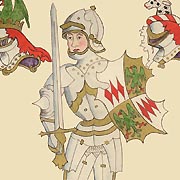
Richard Neville, 16th Earl of Warwick, will forever be known as the "Kingmaker" due to the power he wielded during the Wars of the Roses.
PIRATE
Warwick returned to Calais in the spring of 1458 and began courting friendship with Phillip of Burgundy, an important trade ally. Warwick looked to negotiate Prince Edward's betrothal to a Burgundian princess without King Henry VI and Queen Margaret of Anjou knowledge. Warwick continued to frustrate the royal couple by disregarding a truce between England and the Hanseatic League and plundered the ships of German wool traders as they entered the English Channel.
| Map of 15th Century Calais |
The queen summoned Warwick to London to answer for his piracy and Warwick arrived in the capital with 600 retainers to ward off the queen's threats. Warwick returned to the capital later that year and an accident by the king's scullion nearly left Warwick impaled on a spit in the royal kitchens. Warwick's men, suspicious of a plot, looked to kill the scullion and a fight broke out with the royal servants. Warwick overwhelmed the royal guard, seized the scullion and brought him before the queen. Margaret astutely ordered the kitchen orderly to death for attempted murder but later allowed the scullion to escape and flee to Yorkshire.
Margaret persuaded the Council that it was Warwick who instigated the fight and had them issue an arrest warrant. Warwick fled to Calais but returned when he heard of the queen's intentions of replacing him with Henry Beaufort, 3rd Duke of Somerset, as Captain of Calais. Warwick defiantly stood in front of the Council and reminded them that it was Parliament who appointed him as Captain of Calais and only Parliament could revoke his position. Warwick was attacked as he left the council chambers by retainers loyal to Margaret partisans, Somerset and the Earl of Wiltshire, and Warwick narrowly escaped to Calais.
Richard Duke of York and Warwick's father, Richard Neville, Earl of Salisbury, gathered troops and sent word to Warwick for assistance. Warwick rallied 200 men-at-arms and 400 archers to be commanded by Calais Master Porter, Andrew Trollope, and Warwick left Calais under the watch of his uncle, Lord Fauconberg.
York had rallied his troops near his residence of Ludlow in the Welsh marches and Salisbury travelled south from Middleham, Yorkshire, to join him. Warwick landed in Kent and marched north uncontested through London and on to Warwick Castle but the royal forces reached Warwick ahead of him and blocked the road north towards Salisbury. Warwick continued west and met up with York, and a battle-hardened Salisbury after Warwick's father was victorious in the Battle of Blore Heath.
The Yorkist commanders, after taking communion at Worcester Cathedral, swore an oath of allegiance and respect to the king but Henry VI was persuaded by Margaret to ignore it. The king's forces pursued York south of Ludlow and York's army encamped on the shore of the River Tern, for the Battle of Ludford Bridge.
BETRAYED
York 's outnumbered men were overawed in seeing the royal standard flying across the other side of the bridge and were unwilling to fight against the king himself. Henry VI seized on this and sent word to the Yorkists that a free pardon would be given to anyone, apart from Salisbury, who defected and this offer was too good a opportunity to miss for Trollope. Warwick's Calais contingent came over to the Lancastrians and York was fearful of Trollope informing the royal commanders details of his troop formations.
York, Salisbury and Warwick told their captains that they were to spend the night of October 12 1459 at Ludlow in order to plan their next move. The commanders used the cover of night to make their escape and fled the battlefield. The remaining Yorkist soldiers woke up to see their leaders gone and peacefully surrendered to the king.
 |
| Flee into exile began at Ludford Bridge |
York had taken his second eldest son, Edmund, Earl of Rutland, with him to Ireland whilst Warwick and Salisbury fled to Calais and were accompanied by York's eldest son, Edward, Earl of March. York had left behind his wife Cecily, daughter Margaret, and his youngest sons, George and Richard, to the mercy of the Lancastrian army and the family were found at Ludlow Market Cross. Cecily's sister and Warwick's fellow aunt, Anne, took them into care under the watchful eye of Anne's husband, Duke of Buckingham.
Warwick returned to Calais and was supported by it's people who rallied against Somerset, the newly appointed Captain of Calais. Somerset looked to assert his title by taking Calais for himself but found the city gate locked. Somerset was able to establish a base in nearby Guisnes and appointed Trollope the town's bailiff due, in part, to Trollope's knowledge of the area. Somerset continued to mount attacks on Calais but Warwick remained unnerved.
Warwick still had one of his ships moored in Sandwich and the queen sent the husband of long-time friend, Jacquetta of Luxembourg, to commandeer the vessel. Richard Woodville, who was now Earl Rivers, and his son, Anthony, arrived at Sandwich but were soon taken prisoner by Warwick's supporters. The Woodvilles were taken across the English Channel and Warwick, Salisbury and March ridiculed their captives. Warwick especially berated Earl Rivers for being a son of a squire who had married himself into the nobility to become a lord.
RETURN
Warwick was able to sail uncontested to Ireland to meet with York to plan their return from exile and Warwick, Salisbury and March landed in Sandwich on 26 June 1460. Salisbury stayed behind in London and Warwick marched north with 10,000 men towards the royal forces in Coventry. The Yorkist grievances were taken by three emissaries but were denied access to the king by Buckingham who responded that "the Earl of Warwick shall not come to the King's presence and if he comes he shall die." The two forces met at the Battle of Northampton on 10 July 1460 and Warwick sent message to Buckingham that "at 2 o'clock I will speak with the King or I will die."
Warwick outnumbered the royal army two to one and advanced at 2 o'clock into hard wind and rain. Warwick's men were met with a fierce hail of Lancastrian arrows but the rain had made the royal artillery near useless. March took the vanguard up to the ditch guarding the Lancastrian right flank and were assisted by Lancastrian Lord Grey of Ruthin who had previously been bribed by Warwick and March.
The battle lasted just half an hour once the Yorkists were behind the Lancastrian front lines and the royal troops fled the king's defence. Henry VI had remained in his tent behind the front line and his four lieutenants of Buckingham, Earl of Shrewsbury, Lord Egremont and Lord Beaumont, all died trying to stop the Yorkist approach.
 |
| Warwick kneels to the captured King Henry VI - depicted by Graham Turner |
The Yorkist archer, Henry Mountfort, captured Henry VI and confined him to his royal tent until Warwick and March arrived. The earls knelt before the king and sought forgiveness after taking up arms against him once again in order to challenge those in his Council. The king had no choice but to accept and Warwick once again led the king back to London.
York arrived in London on 10 October 1460 and proclaimed his intentions by placing a hand on the throne and replied, "I know of no person in this realm that owes not to wait on me, rather than I of him" when asked by the Archbishop of Cantebury if York wished to see the king.
York's actions alienated Warwick and Salisbury. The Nevilles were angry at York for not consulting them and they remained hesitant about deposing the king. Warwick remonstrated with York in the pretender's Westminster lodgings and Rutland defended his father. March, fully aware of Warwick's power, calmed his younger brother, and a simmering Warwick left the apartments, speaking only with March.
Aware of the dissension in his own ranks, York detailed his hereditary claim to the throne to Parliament who passed an Act of Accord on 24 October 1460 that ordered York (and his heirs) as successors to the throne after Henry VI.
Margaret of Anjou had fled north with her now-disinherited son after her husband's defeat at Northampton and had travelled from Wales to Scotland. Margaret was negotiating terms with the Scottish king, James III, and Lancastrian forces began to build just south of the Scottish border.
York was disturbed by the news of a growing northern army and marshaled his troops by having March garrisoned to the west in the Welsh Marches whereas Warwick oversaw London. York, Salisbury and Rutland now marched north to meet the Lancastrians, and their deaths, at Battle of Wakefield.


